Google Maps Audit
Audit your Google Business Profile.
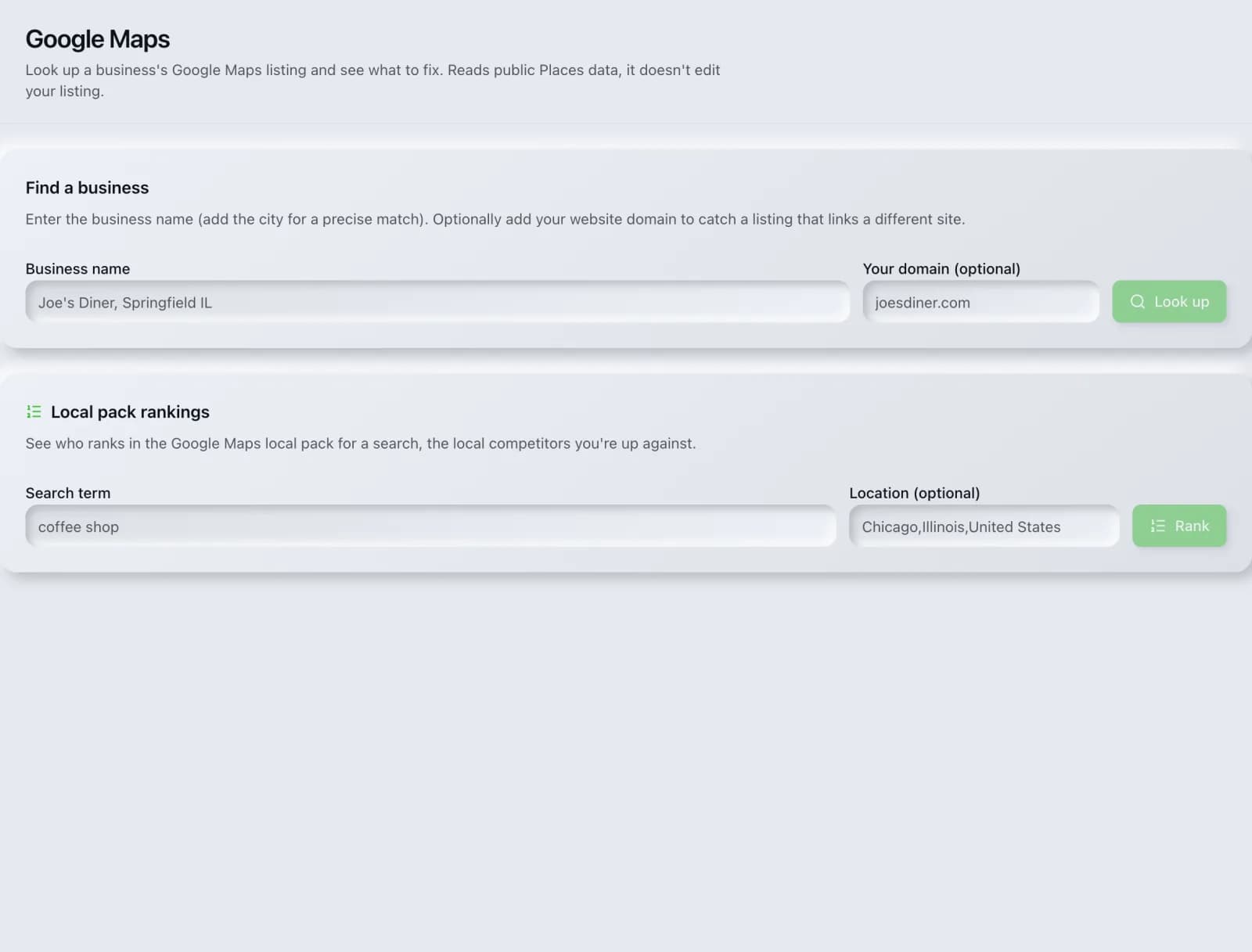
Audit a Google Business Profile and local-pack presence to find what's holding back your local rankings.
What you get
Everything Google Maps Audit delivers, out of the box.
Business Profile audit
Local-pack ranking check
Review & category signals
Competitor local view
How it works
From input to insight in three steps.
Enter your URL or keyword
Point Google Maps Audit at any page, domain or search term, yours or a competitor's.
SEO Roger analyzes it
We run the analysis with DataForSEO's local SERP data in seconds.
Get a prioritized report
Read a clear, ranked breakdown of exactly what to do next.
What is Google Maps Audit?
Google Maps Audit reviews your Google Business Profile and local pack presence to find what is holding back your local rankings: incomplete profile information, category selection, review signals, photos and consistency with the details published on your website. Auditing a profile is free; a local-pack lookup, which shows who is ranking around you, costs 2 credits.
How to use Google Maps Audit
From signup to shipped fix, this is the whole loop.
- 1Create a free accountSign up in under a minute. No credit card is required, and your first site scan works without an account at all.
- 2Point Google Maps Audit at your siteEnter the URL or domain you want to analyze. You can run it on your own site or on a competitor's.
- 3Let it pull the live dataGoogle Maps Audit fetches the current state of the page or domain and runs its checks. Most runs finish in seconds.
- 4Read the ranked findingsResults come back ordered by impact rather than by count, so the issue costing you the most traffic is at the top, not buried under cosmetic warnings.
- 5Ship the fix, then re-runApply the recommended change, or let Roger AI draft it for you, then run the tool again to confirm the issue is resolved and track the improvement.
Why Google Maps Audit matters
For any business serving a physical area, the local pack sits above the ordinary results and captures a large share of the clicks, and it is ranked by a different system with different inputs. A business can rank respectably in organic results and be effectively absent from the map results that most local searchers actually use.
Search is no longer only Google. ChatGPT, Google AI Overviews, Perplexity, Gemini and Claude answer a growing share of queries by reading the same pages crawlers do, then citing a handful of sources. SEO Roger keeps both audiences in view: the classic SERP and the AI answer, from one workspace.
Who it's for
- Local businesses competing for the map pack in their area
- In-house SEOs who need local and map-pack visibility without stitching three tools together
- Agencies and consultants producing client-ready findings, fast
- Founders and marketers who want the fix, not just the metric
Google Maps Audit in depth
Local ranking runs on different inputs
Google describes local ranking in terms of relevance, distance and prominence. Distance you cannot change. Relevance comes largely from how completely and accurately your profile describes what you do, particularly your categories. Prominence combines your web presence with review signals. This is why local SEO work looks so different from ordinary SEO work: the profile itself is the primary asset, not your site.
Primary category is the highest-leverage field
Your primary category does more to determine which searches you appear for than almost anything else on the profile, and it is frequently set once at signup and never revisited. Choosing the category that most precisely describes your main service, rather than a broader one that feels more inclusive, is often the single most effective change available.
NAP consistency across the web
Your name, address and phone number should be identical everywhere they appear: your profile, your website, directories and social accounts. Inconsistencies, including formatting differences such as Street against St, weaken Google's confidence that these listings describe the same business. This is tedious work with a real payoff, and it is why local audits always check the website against the profile.
Reviews as a ranking and conversion signal
Review volume, recency, rating and whether you respond all feed local prominence, and they simultaneously drive whether someone chooses you once they see you. Responding to reviews, including critical ones, is visible to both the algorithm and the reader. A steady flow of recent reviews outperforms a large number that all arrived two years ago.
Google Maps Audit questions, answered
How many credits does it cost?
The profile audit itself costs nothing. The local-pack lookup, which shows which businesses currently rank for a search in a location, costs 2 credits, because that one calls a paid data provider.
Why do I rank differently depending on where I search from?
Because distance from the searcher is a direct ranking input for local results. Your visibility genuinely varies across a city, which is why checking rankings from your own office is misleading and why local rank tracking uses fixed reference points rather than your current location.
How important are reviews for local ranking?
Significant, and they work on two levels: they feed prominence in the ranking, and they strongly influence whether someone picks you once they see you. Recency and response rate matter alongside the raw count and average.
Should I add every category that applies to my business?
Add the ones that genuinely describe services you offer, and be precise about the primary one, which carries the most weight. Padding the list with loosely related categories dilutes relevance rather than broadening it.
Does my website still matter for local rankings?
Yes. Prominence draws on your overall web presence, and your site is where Google confirms the details on your profile. A well-optimized profile attached to a weak or inconsistent website underperforms one supported by a solid site.
How long do local ranking changes take?
Profile edits can be reflected within days, considerably faster than organic ranking changes. Signals that build over time, particularly reviews and citations, work on a scale of weeks to months.
Ready to try Google Maps Audit?
Create a free account and run it in minutes, plus 55+ other SEO and AI-visibility tools in the same workspace.