
Backlink Gap
Steal your competitors' best links.
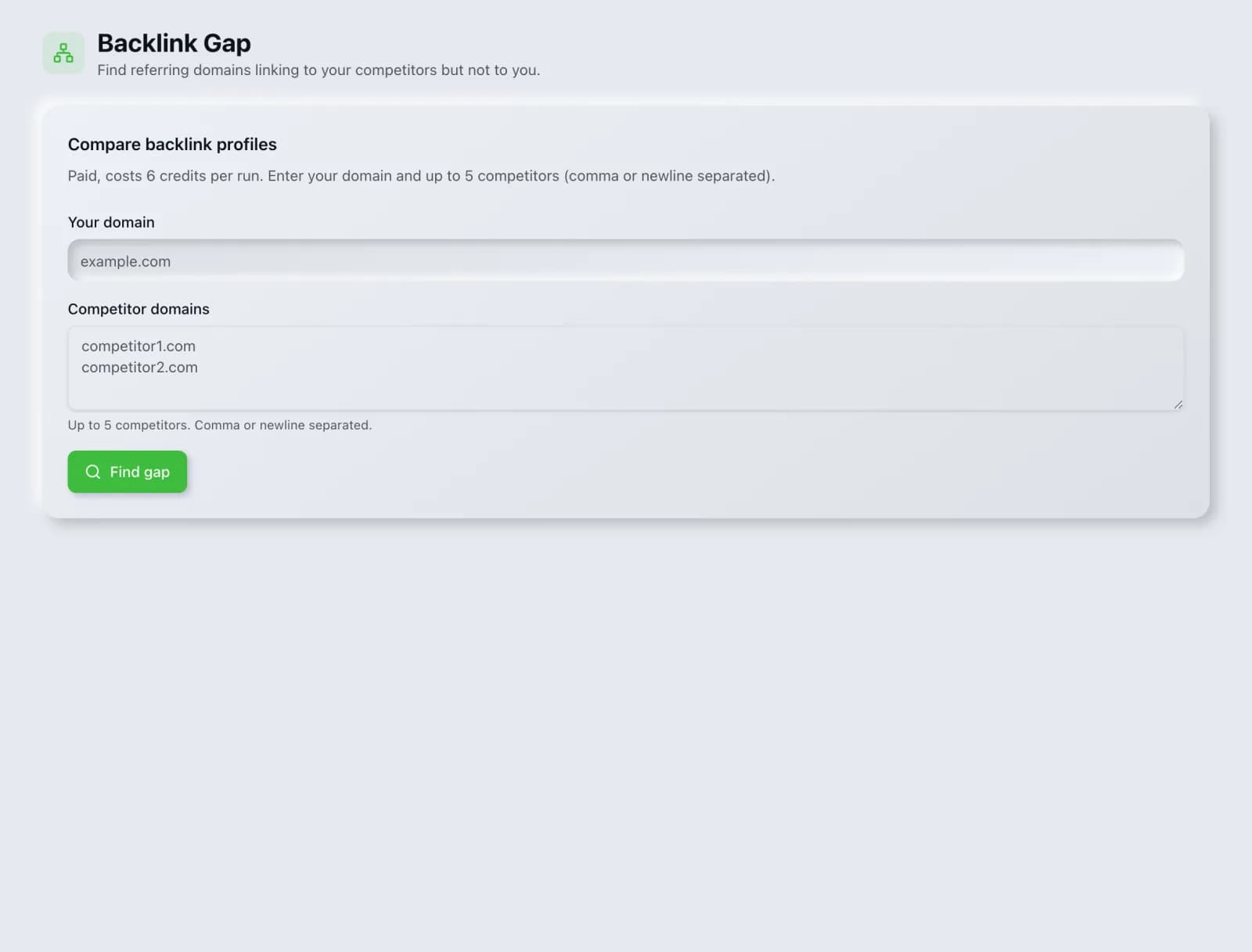
Find the referring domains linking to your competitors but not to you: ranked by authority and how many rivals they link to, so you know exactly where to earn links next.
What you get
Everything Backlink Gap delivers, out of the box.
Competitor referring-domain diff
Ranked by authority
Multi-competitor overlap
Actionable link targets
How it works
From input to insight in three steps.
Enter your URL or keyword
Point Backlink Gap at any page, domain or search term, yours or a competitor's.
SEO Roger analyzes it
We run the analysis with DataForSEO's live SEO index in seconds.
Get a prioritized report
Read a clear, ranked breakdown of exactly what to do next.
Related tools
More from Competitive Research.
What is Backlink Gap?
Backlink Gap finds the referring domains that link to your competitors but not to you. You enter your domain and up to several rivals, and it returns the sites linking to them ranked by authority and by how many of your competitors each one links to, which turns link building from cold outreach into a prioritized list of sites already proven to link to businesses like yours. It costs 2 credits for each domain fetched, meaning your own plus each competitor, so a three-way comparison is 6 credits.
How to use Backlink Gap
From signup to shipped fix, this is the whole loop.
- 1Create a free accountSign up in under a minute. No credit card is required, and your first site scan works without an account at all.
- 2Point Backlink Gap at your siteEnter the URL or domain you want to analyze. You can run it on your own site or on a competitor's.
- 3Let it pull the live dataBacklink Gap fetches the current state of the page or domain and runs its checks. Most runs finish in seconds.
- 4Read the ranked findingsResults come back ordered by impact rather than by count, so the issue costing you the most traffic is at the top, not buried under cosmetic warnings.
- 5Ship the fix, then re-runApply the recommended change, or let Roger AI draft it for you, then run the tool again to confirm the issue is resolved and track the improvement.
Why Backlink Gap matters
The hardest part of link building is not persuasion, it is deciding who to contact. Most outreach fails because it goes to sites that were never going to link to anyone in your category. A site that already links to three of your competitors has demonstrated both that it covers your subject and that it accepts this kind of link. That is a fundamentally warmer prospect than a name from a list of high-authority domains.
Search is no longer only Google. ChatGPT, Google AI Overviews, Perplexity, Gemini and Claude answer a growing share of queries by reading the same pages crawlers do, then citing a handful of sources. SEO Roger keeps both audiences in view: the classic SERP and the AI answer, from one workspace.
Who it's for
- In-house SEOs who need competitive and backlink intelligence without stitching three tools together
- Agencies and consultants producing client-ready findings, fast
- Founders and marketers who want the fix, not just the metric
Backlink Gap in depth
Why overlap count matters more than authority
The instinct is to sort by domain authority and start at the top. The more useful sort is by how many competitors a domain links to. A site linking to one rival might be a one-off, a personal relationship or a paid placement. A site linking to four rivals is almost certainly a category resource, a roundup, a directory or a journalist who covers your space, and it is odd that you are missing from it. Those are the links you can realistically win.
Choosing competitors properly
The output is only as good as the domains you compare against, and the common mistake is entering aspirational giants. If you run a ten-page consultancy and compare yourself against a company with a newsroom and a PR team, the gap will be full of national press coverage you cannot act on. Compare against businesses roughly your size that outrank you, and the results become a to-do list rather than a wish list.
Reading the results without chasing everything
Some gaps are not really gaps. Competitor links from their own parent company, their agency's client page, a conference they sponsored or a partner integration are not opportunities, they are relationships. Filter those out mentally as you scan. What remains, the genuinely open resources, roundups, directories and editorial mentions, is where your outreach time should go.
What to do with the list
Group the surviving prospects by what kind of link they are. A resource page needs a note explaining why your page belongs on it. A roundup needs you to be relevant to the next one. A directory usually just needs a submission. A journalist needs a reason to write about you, not a link request. Sending the same outreach email to all four is why most link building has a low response rate.
Backlink Gap questions, answered
How many credits does Backlink Gap cost?
2 credits per domain fetched, counting your own plus each competitor, so comparing against two rivals is three domains and 6 credits. It is metered this way because the tool pulls a full referring-domain list for every domain in the comparison, so a five-competitor run genuinely costs several times what a one-competitor run does. Backlink data comes from a commercial index rather than something we can crawl ourselves, which is why it is paid at all.
How many competitors should I compare?
Three to five is the useful range. With one or two you cannot tell a genuine category resource from a one-off relationship. Beyond five, the overlap thins out and you spend credits on domains that link to exactly one competitor, which is the least actionable part of the report.
Will finding these links actually get me the links?
No, and it is worth being clear about that. This tool tells you who to ask. It does not do the asking, and it cannot make a site link to you. What it changes is your hit rate: outreach to sites that already link to three competitors performs far better than outreach to a generic high-authority list, because relevance and demonstrated willingness are already established.
Why do some competitor links look impossible to replicate?
Because some of them are. Coverage from a funding announcement, a link from a parent company, a placement earned by a full-time PR team or a partnership integration are all real links that you cannot copy by sending an email. Read past them. The replicable links, resource pages, roundups, directories and topical blogs, are the reason to run the report.
How does this differ from Backlink Analysis?
Backlink Analysis looks inward at the links you already have, which is what you want for auditing your profile or preparing a disavow. Backlink Gap looks outward at links you do not have yet. One is defence, the other is offence.
How often should I run it?
Quarterly is plenty for most sites. Referring domain profiles move slowly, and running it monthly mostly spends credits confirming what you already knew. Run it more often only if you are in an active outreach campaign and want to see which prospects have converted.
Ready to try Backlink Gap?
Create a free account and run it in minutes, plus 55+ other SEO and AI-visibility tools in the same workspace.