Keyword Gap
Find the keywords you're missing.
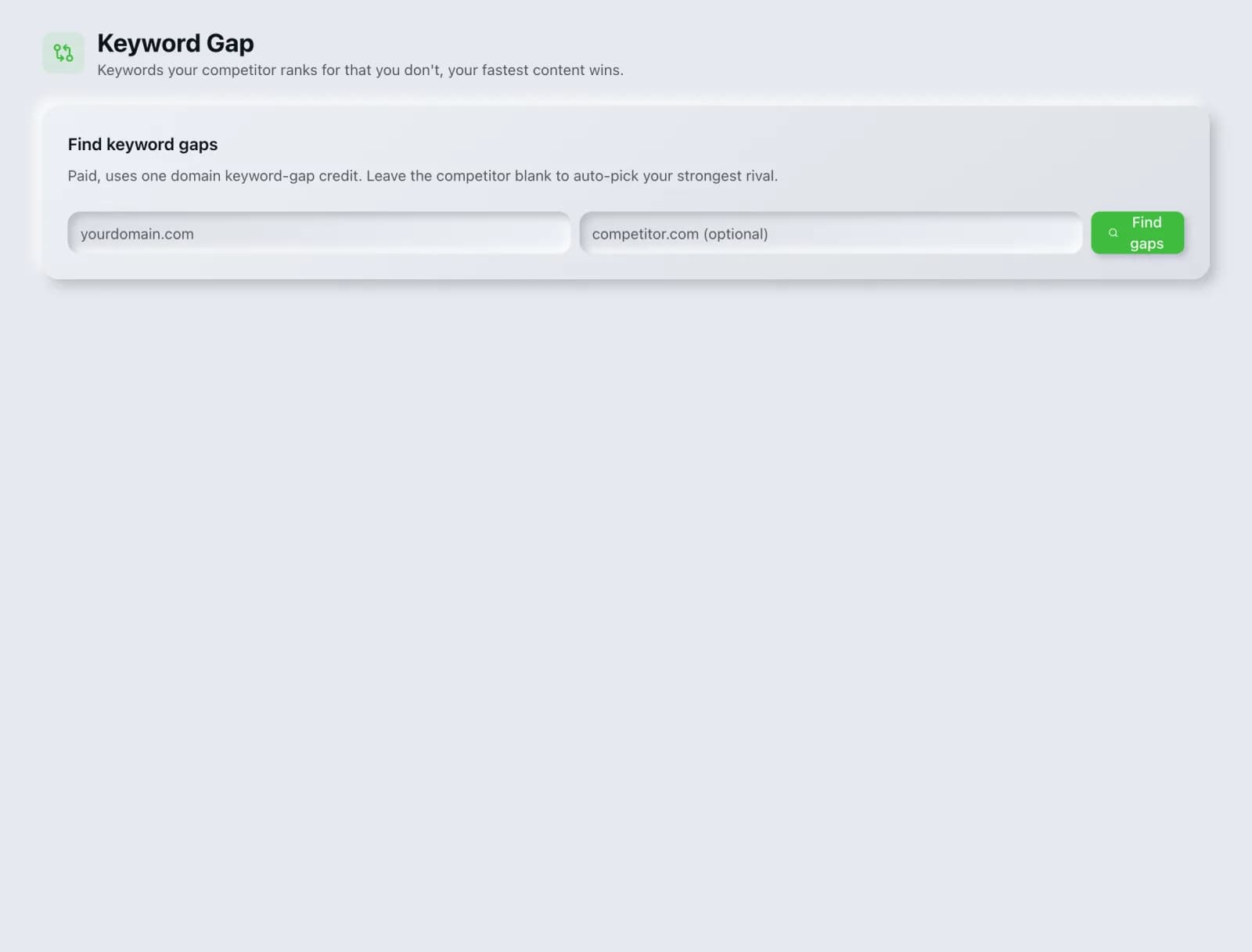
See the keywords a competitor ranks for that you don't: your fastest content wins, with volume, intent and CPC for each opportunity.
What you get
Everything Keyword Gap delivers, out of the box.
Missing-keyword discovery
Volume, intent & CPC
Auto-picks strongest rival
Prioritized content gaps
How it works
From input to insight in three steps.
Enter your URL or keyword
Point Keyword Gap at any page, domain or search term, yours or a competitor's.
SEO Roger analyzes it
We run the analysis with DataForSEO's live SEO index in seconds.
Get a prioritized report
Read a clear, ranked breakdown of exactly what to do next.
Related tools
More from Competitive Research.
What is Keyword Gap?
Keyword Gap shows the keywords your competitors rank for and you do not, with search volume, intent and cost per click attached to each one. Instead of inventing keyword ideas and hoping they have demand, you start from terms that are already sending traffic to businesses in your market. It costs 1 credit per run.
How to use Keyword Gap
From signup to shipped fix, this is the whole loop.
- 1Create a free accountSign up in under a minute. No credit card is required, and your first site scan works without an account at all.
- 2Point Keyword Gap at your siteEnter the URL or domain you want to analyze. You can run it on your own site or on a competitor's.
- 3Let it pull the live dataKeyword Gap fetches the current state of the page or domain and runs its checks. Most runs finish in seconds.
- 4Read the ranked findingsResults come back ordered by impact rather than by count, so the issue costing you the most traffic is at the top, not buried under cosmetic warnings.
- 5Ship the fix, then re-runApply the recommended change, or let Roger AI draft it for you, then run the tool again to confirm the issue is resolved and track the improvement.
Why Keyword Gap matters
Keyword research done from a blank page tends to produce terms you already thought of, weighted toward how you describe your own product rather than how customers describe their problem. Competitor rankings solve that by revealing the vocabulary the market actually uses, including the terms you would never have guessed because they use a word your team does not.
Search is no longer only Google. ChatGPT, Google AI Overviews, Perplexity, Gemini and Claude answer a growing share of queries by reading the same pages crawlers do, then citing a handful of sources. SEO Roger keeps both audiences in view: the classic SERP and the AI answer, from one workspace.
Who it's for
- In-house SEOs who need competitive and backlink intelligence without stitching three tools together
- Agencies and consultants producing client-ready findings, fast
- Founders and marketers who want the fix, not just the metric
Keyword Gap in depth
The four groups in every gap report
Sort the output into missing, weak, strong and untapped. Missing means they rank and you do not appear at all, which is the classic content gap. Weak means you both rank but they are ahead, which is usually an optimization job rather than a new page. Strong means you are ahead and should defend it. Untapped means neither of you ranks well, which is either a genuine opening or a sign the term is not worth the effort. Most of your near-term wins live in weak, not missing, because improving page nine to page two is cheaper than creating a page from nothing.
Intent decides what you build
A gap term is only useful once you know what the searcher wants. Informational terms need an article that teaches something. Commercial terms need a comparison or a category page. Transactional terms need a product or pricing page. Publishing a blog post against a transactional query is one of the most common wasted efforts in content marketing, because the results ranking for it are all product pages and an article will not displace them.
Volume is not the ranking criterion
The highest-volume gaps are usually the head terms your competitors rank for because they have spent years and considerable link equity earning that position. A term with 200 searches a month that matches exactly what you sell will earn more revenue than a term with 20,000 that brings people who are not buying anything. Read volume alongside cost per click, which is the closest public proxy for commercial value, and alongside your realistic ability to compete.
Turning the report into a content plan
Group the surviving terms into clusters that a single page can satisfy, rather than treating each keyword as its own page. Ten near-identical terms about the same question are one article, not ten, and building ten thin pages to cover them is precisely the pattern search engines demote. Cluster first, then order the clusters by intent match and competitiveness.
Keyword Gap questions, answered
How many credits does Keyword Gap cost?
1 credit per run, and the result is cached for 24 hours per domain and competitor pair, so re-running the same comparison within a day costs nothing further.
Which competitors should I use?
Search competitors, not business competitors, and the two are often different. The sites beating you in the results may include publishers, review sites and marketplaces that do not sell what you sell but do occupy the space you want. Comparing against the domains actually ranking for your target terms produces a more useful gap than comparing against the companies your sales team names.
Is the search volume exact?
No. Volume figures from every provider, ours included, are modelled estimates derived from clickstream and ad data, not counts from Google. They are reliable for comparing terms against each other and unreliable as absolute traffic forecasts. Use them to rank opportunities, not to promise a number to a client.
Should I target every keyword in the gap?
Definitely not. A gap report on a mature competitor can list thousands of terms, and most of them are irrelevant, too competitive, or already covered by a page you have. Filter hard by intent match and by whether you can realistically compete, then cluster what survives. A focused twenty is worth more than an undifferentiated two thousand.
How is this different from Keyword Research?
Keyword Research starts from a seed term and expands outward into related ideas, which is what you want when exploring a new area. Keyword Gap starts from competitor rankings and works backward, which is what you want when you already know who you are competing with and need to find where they are beating you.
How often should I run it?
Quarterly, or when a competitor's visibility visibly changes. Ranking profiles do not shift enough month to month to justify the credit spend, and you are better off spending that time executing the plan from the last run than generating a new one.
Ready to try Keyword Gap?
Create a free account and run it in minutes, plus 55+ other SEO and AI-visibility tools in the same workspace.