
Competitor Comparison
Put your site head-to-head with rivals.
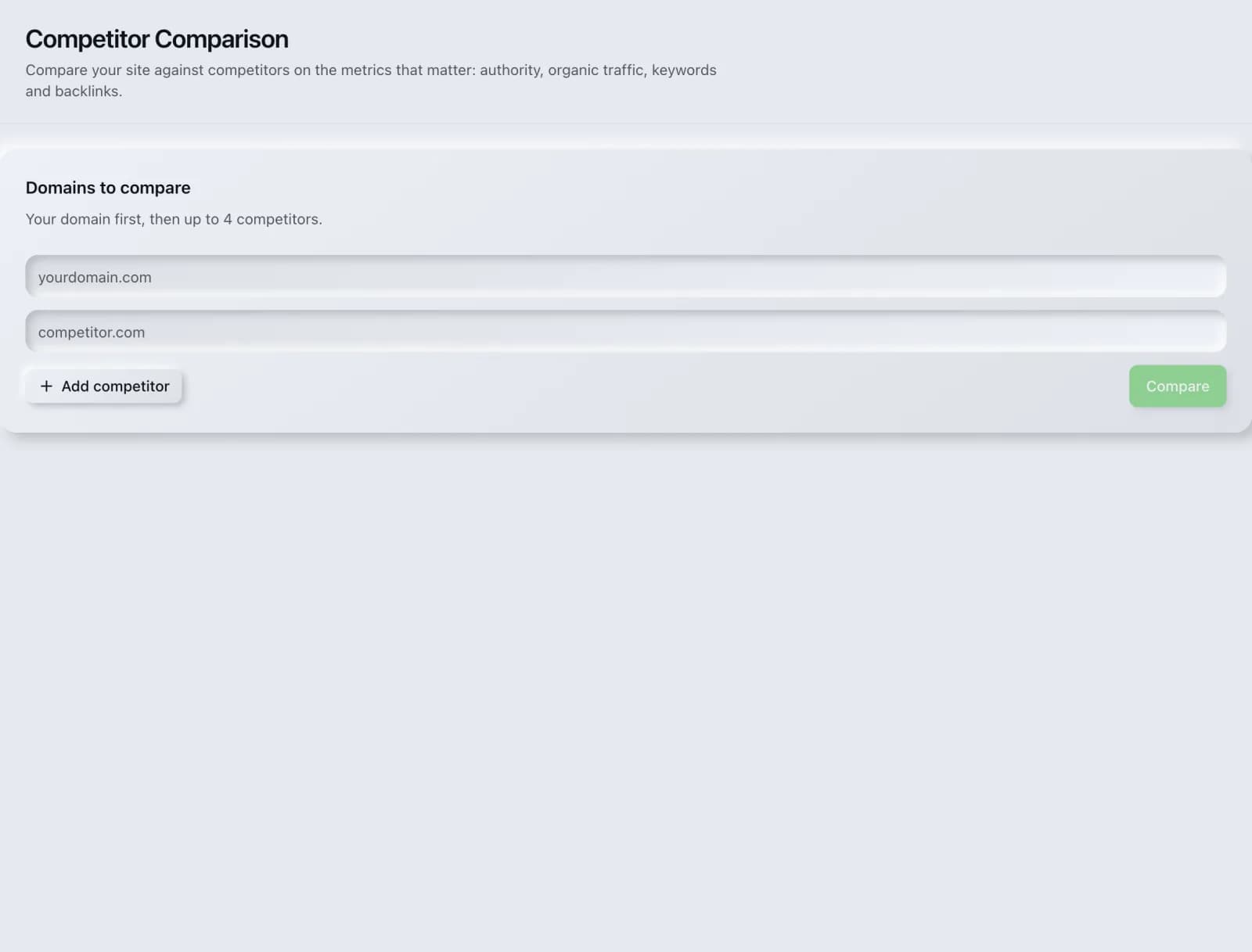
Compare your domain against competitors across authority, keywords, traffic and backlinks to find where you can win.
What you get
Everything Competitor Comparison delivers, out of the box.
Side-by-side metrics
Keyword & backlink gaps
Share-of-voice view
Export to client reports
How it works
From input to insight in three steps.
Enter your URL or keyword
Point Competitor Comparison at any page, domain or search term, yours or a competitor's.
SEO Roger analyzes it
We run the analysis with DataForSEO's live SEO index in seconds.
Get a prioritized report
Read a clear, ranked breakdown of exactly what to do next.
Related tools
More from Competitive Research.
What is Competitor Comparison?
Competitor Comparison puts your domain side by side with your rivals across authority, keyword footprint, estimated traffic and backlink profile, so you can see in one view where you lead, where you trail and which gap is actually worth closing. It costs 12 credits for each domain in the comparison, and domains already in the 24-hour cache are free.
How to use Competitor Comparison
From signup to shipped fix, this is the whole loop.
- 1Create a free accountSign up in under a minute. No credit card is required, and your first site scan works without an account at all.
- 2Point Competitor Comparison at your siteEnter the URL or domain you want to analyze. You can run it on your own site or on a competitor's.
- 3Let it pull the live dataCompetitor Comparison fetches the current state of the page or domain and runs its checks. Most runs finish in seconds.
- 4Read the ranked findingsResults come back ordered by impact rather than by count, so the issue costing you the most traffic is at the top, not buried under cosmetic warnings.
- 5Ship the fix, then re-runApply the recommended change, or let Roger AI draft it for you, then run the tool again to confirm the issue is resolved and track the improvement.
Why Competitor Comparison matters
Absolute SEO numbers mean very little on their own. Knowing you have four hundred referring domains tells you nothing until you know the sites outranking you have four thousand, or four hundred and twenty. Competitive context converts a meaningless metric into a decision about whether to compete on links, on content, or to pick a different battle entirely.
Search is no longer only Google. ChatGPT, Google AI Overviews, Perplexity, Gemini and Claude answer a growing share of queries by reading the same pages crawlers do, then citing a handful of sources. SEO Roger keeps both audiences in view: the classic SERP and the AI answer, from one workspace.
Who it's for
- In-house SEOs who need competitive and backlink intelligence without stitching three tools together
- Agencies and consultants producing client-ready findings, fast
- Founders and marketers who want the fix, not just the metric
Competitor Comparison in depth
The comparison tells you which lever to pull
The shape of the gap dictates the strategy. If you trail badly on referring domains but match on keyword coverage, your content is fine and links are the constraint. If you match on links but they rank for five times as many terms, you have authority you are not using and the answer is more content. If you lead on both and still rank lower, the problem is usually technical or intent mismatch. Reading the pattern is more useful than reading any single number.
Pick comparators you can learn from
There is a strong pull toward comparing yourself with the biggest name in your category, and it is almost always a waste. The gap will be so large that every metric says the same unhelpful thing. Compare against sites one tier above you, the ones you could plausibly overtake in a year, and the differences become small enough to be diagnostic and to act on.
What these numbers are and are not
Estimated traffic is modelled from ranking positions and volume estimates, not measured from anyone's analytics, and it can be wrong by a wide margin for any individual site, particularly one with heavy brand, direct or paid traffic. Authority scores are third-party models, not Google metrics. Both are useful for relative comparison, which is exactly what this tool does, and neither should be quoted as fact about another business.
Repeat it to see direction
A single comparison is a snapshot and cannot tell you who is winning. The same comparison quarterly tells you the far more valuable thing: whether the gap is closing or widening. A competitor adding referring domains three times faster than you is a strategic problem that no single-point-in-time report would reveal.
Competitor Comparison questions, answered
How many credits does it cost?
12 credits per domain, because each domain in the comparison runs a full Domain Overview behind the scenes. Comparing yourself against two rivals is three domains, so 36 credits on a cold run. Every domain rides a 24-hour cache, so a domain you already looked at today is free, and re-running the same comparison costs nothing.
How accurate is the estimated traffic?
Directionally useful, individually unreliable. It is modelled from ranking data and volume estimates rather than measured, so it systematically misses direct, brand, email and paid traffic. Treat it as a way to compare sites on the same basis, not as a claim about how much traffic a competitor genuinely receives.
Is the authority score a Google metric?
No. Google does not publish a public authority score. Every score of this kind, ours included, is a third-party model of link strength. It correlates loosely with ranking ability and is useful for comparing domains, but it is not what Google uses and improving it is not itself a ranking strategy.
How many competitors can I compare at once?
The tool is built for head-to-head and small-group comparison, which is also where it is most readable. If you want to compare a larger set on lighter metrics, Bulk Page Comparison is the better fit, and Domain Overview gives you the full picture for any single domain.
Who counts as a competitor for this?
Whoever occupies the search results you want, which frequently includes sites that are not business competitors at all. Review sites, publishers and marketplaces often own the terms you are chasing. Include them, because they are the ones you actually have to outrank.
How does this differ from Domain Overview?
Domain Overview is a deep report on one domain. Competitor Comparison is a shallower report across several, aligned so the differences stand out. Use the comparison to work out who to study, then run Domain Overview on whoever looks most instructive.
Ready to try Competitor Comparison?
Create a free account and run it in minutes, plus 55+ other SEO and AI-visibility tools in the same workspace.