AI Answer Simulator
See which blocks an AI would actually quote.
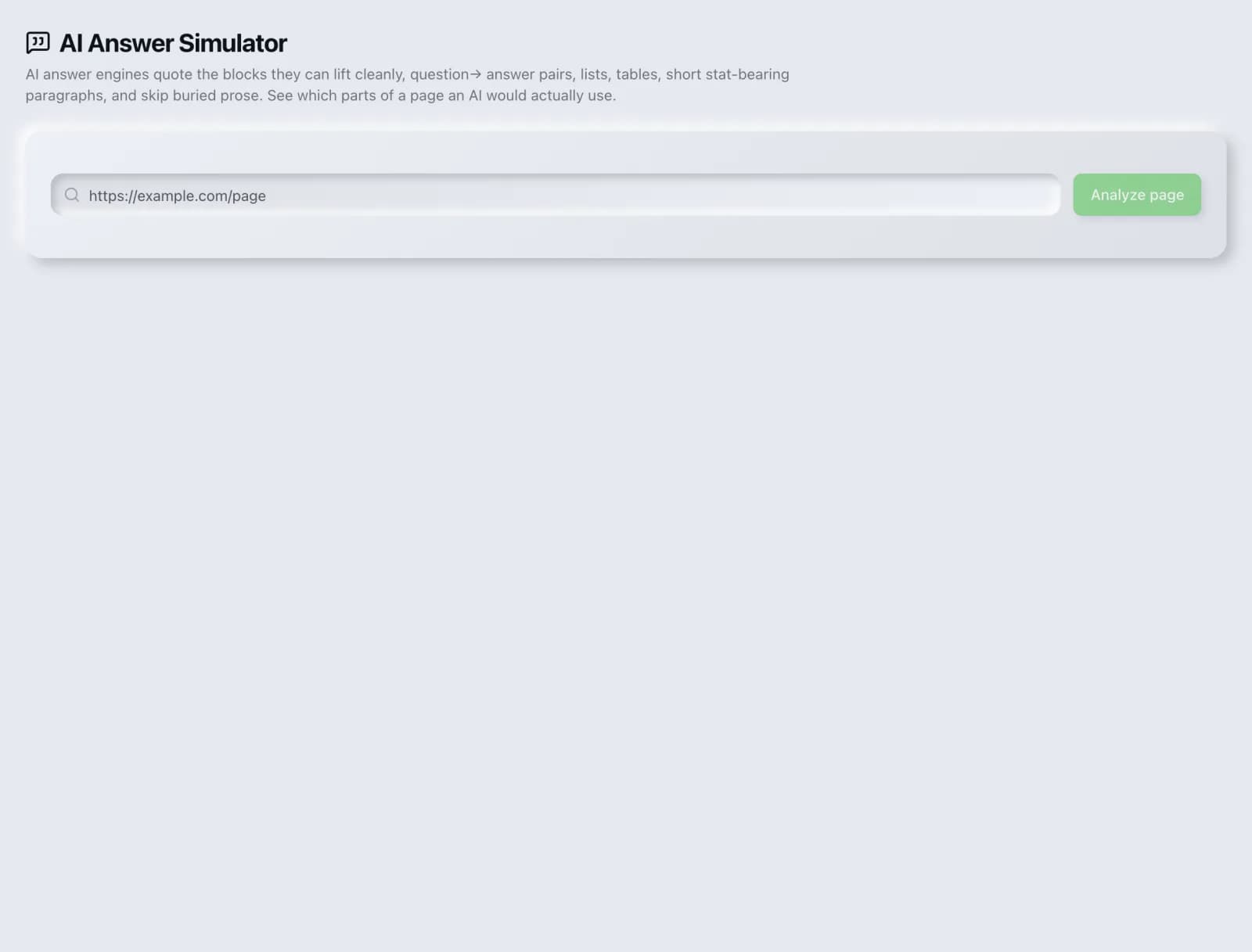
Paste a page and see which passages an AI would lift into an answer, so you can write content that gets quoted.
What you get
Everything AI Answer Simulator delivers, out of the box.
Quote-likelihood per block
Rewrite guidance
Structure recommendations
Free to run
How it works
From input to insight in three steps.
Enter your URL or keyword
Point AI Answer Simulator at any page, domain or search term, yours or a competitor's.
SEO Roger analyzes it
We run the analysis with Claude across the major AI engines in seconds.
Get a prioritized report
Read a clear, ranked breakdown of exactly what to do next.
Related tools
More from AI Visibility.
What is AI Answer Simulator?
The AI Answer Simulator takes a page and shows which passages an AI would be most likely to lift into an answer, so you can see whether your content is structured to be quoted. It is free on every plan.
How to use AI Answer Simulator
From signup to shipped fix, this is the whole loop.
- 1Create a free accountSign up in under a minute. No credit card is required, and your first site scan works without an account at all.
- 2Point AI Answer Simulator at your siteEnter the URL or domain you want to analyze. You can run it on your own site or on a competitor's.
- 3Let it pull the live dataAI Answer Simulator fetches the current state of the page or domain and runs its checks. Most runs finish in seconds.
- 4Read the ranked findingsResults come back ordered by impact rather than by count, so the issue costing you the most traffic is at the top, not buried under cosmetic warnings.
- 5Ship the fix, then re-runApply the recommended change, or let Roger AI draft it for you, then run the tool again to confirm the issue is resolved and track the improvement.
Why AI Answer Simulator matters
Writing to be quoted is a different discipline from writing to be read, and most people cannot assess their own content for it because they already know what the page says. A passage that seems perfectly clear to its author is often meaningless in isolation, because it depends on the three paragraphs above it. Seeing which blocks stand alone makes that failure visible.
Search is no longer only Google. ChatGPT, Google AI Overviews, Perplexity, Gemini and Claude answer a growing share of queries by reading the same pages crawlers do, then citing a handful of sources. SEO Roger keeps both audiences in view: the classic SERP and the AI answer, from one workspace.
Who it's for
- Brands that want to be recommended by ChatGPT, Perplexity and AI Overviews, not just ranked in Google
- In-house SEOs who need visibility inside AI answer engines without stitching three tools together
- Agencies and consultants producing client-ready findings, fast
- Founders and marketers who want the fix, not just the metric
AI Answer Simulator in depth
Self-contained is the whole test
An extractable passage answers a question without needing anything around it. That means no opening pronoun referring to a previous paragraph, no phrase like as we discussed above, no dependency on a heading to make sense. Good writing often builds context deliberately, which makes it flow well and makes it unquotable. The fix is not worse writing; it is including one self-contained statement of the answer near the top of each section.
The answer goes first
Journalists have called this the inverted pyramid for a century and it applies directly here. State the answer, then explain, qualify and expand. Content that builds toward a conclusion at the end may be more satisfying to read straight through, but it gives an extraction system nothing usable in the first pass, and readers scanning for one fact will leave before reaching it.
Specificity is what makes a passage worth quoting
Systems assembling factual answers favour passages containing something concrete: a number, a date, a threshold, a named standard, a defined process. A sentence saying a process usually takes a while is unusable. A sentence saying it typically takes two to four weeks is quotable. Vagueness is often a hedge against being wrong, and the cost of that hedge is never being cited.
Use it as a revision pass
The practical workflow is to write the piece properly for humans first, then run it through here and look at what surfaced. If none of the passages covering your key point stand alone, add a direct statement of that point immediately under its heading. That single habit does most of the work, and it improves the page for skimming readers at the same time.
AI Answer Simulator questions, answered
Does it cost credits?
No. The AI Answer Simulator is free on every plan.
Does this show what ChatGPT or Perplexity will actually say?
No, and that is an important limit. It models the properties that make a passage extractable: self-containment, directness, specificity and structure. It does not query those engines and cannot predict their output, which depends on proprietary retrieval, the exact prompt and factors outside your page. Use it to improve your content's extractability, and use the AI Citation Tracker to check real citation behaviour.
Should I restructure everything I have published?
No. Start with the pages that target questions people actually ask and that already get traffic or rank reasonably. Restructuring an archive nobody reads is effort spent where nothing can come back. A handful of important pages will deliver nearly all of the benefit.
Does writing for extraction make content worse to read?
Done well, it improves it. Leading with the answer and being specific are the same habits that make writing clear for people, particularly the majority who scan rather than read. It goes wrong when a page becomes a series of disconnected snippets with no argument holding it together, which serves nobody.
How long should a quotable passage be?
Roughly forty to sixty words tends to work for a direct answer: long enough to be complete, short enough to be lifted whole. That is a guideline rather than a rule, and a clear two-sentence answer beats a padded one that hits a target length.
Does adding schema help with extraction?
It helps engines understand what your content is, particularly FAQ and HowTo structures that map to question-and-answer formats. It does not compensate for content that does not clearly answer the question. Structure the prose first, then add markup that describes it accurately.
Ready to try AI Answer Simulator?
Create a free account and run it in minutes, plus 55+ other SEO and AI-visibility tools in the same workspace.