
SEO Strategist
An AI SEO strategist that builds your roadmap.
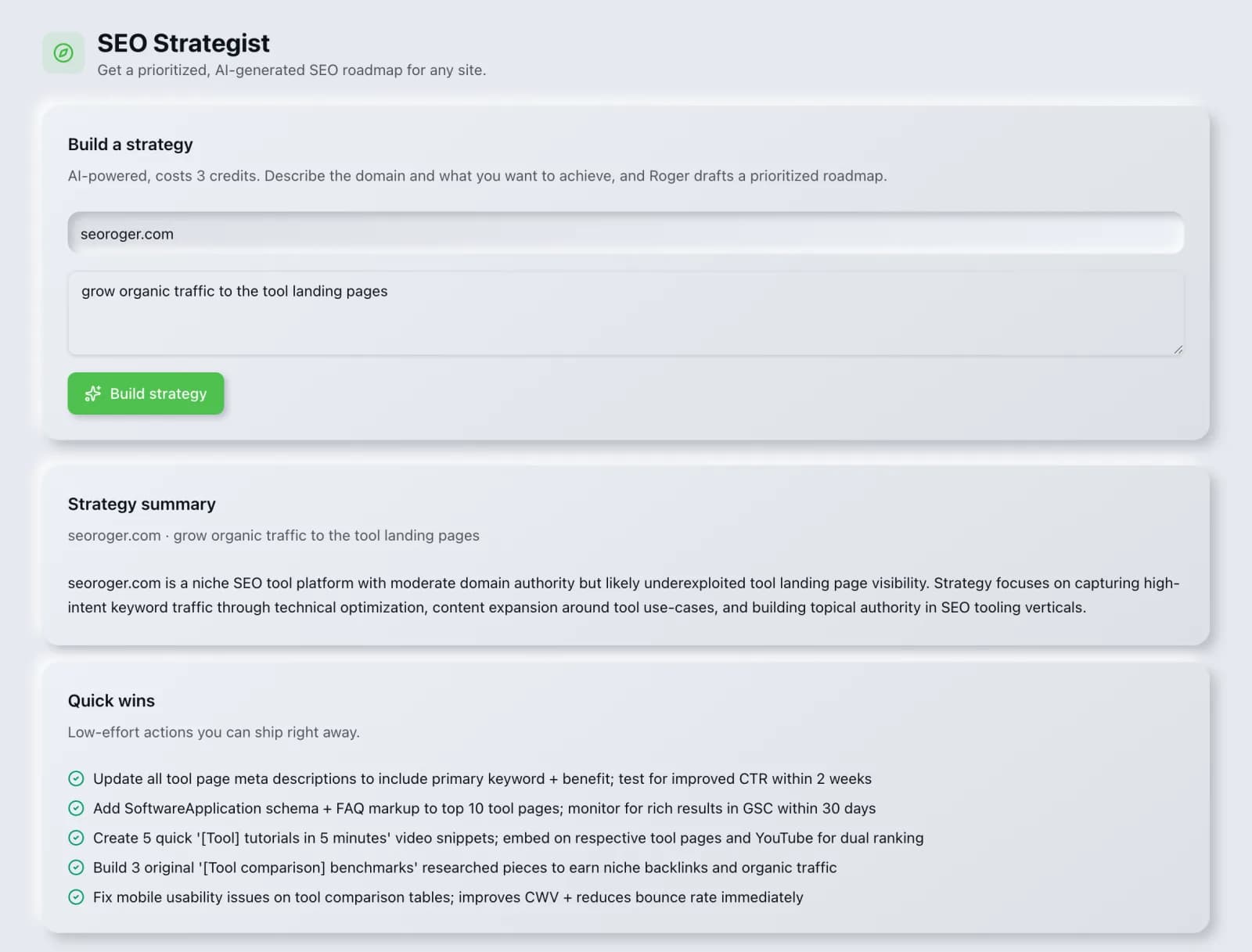
Give it a site and a goal and get a prioritized SEO roadmap: pillars scored by priority, effort and impact, plus quick wins and KPIs to track.
What you get
Everything SEO Strategist delivers, out of the box.
Prioritized strategy pillars
Effort vs impact scoring
Quick wins to start today
KPIs to measure
Where you start
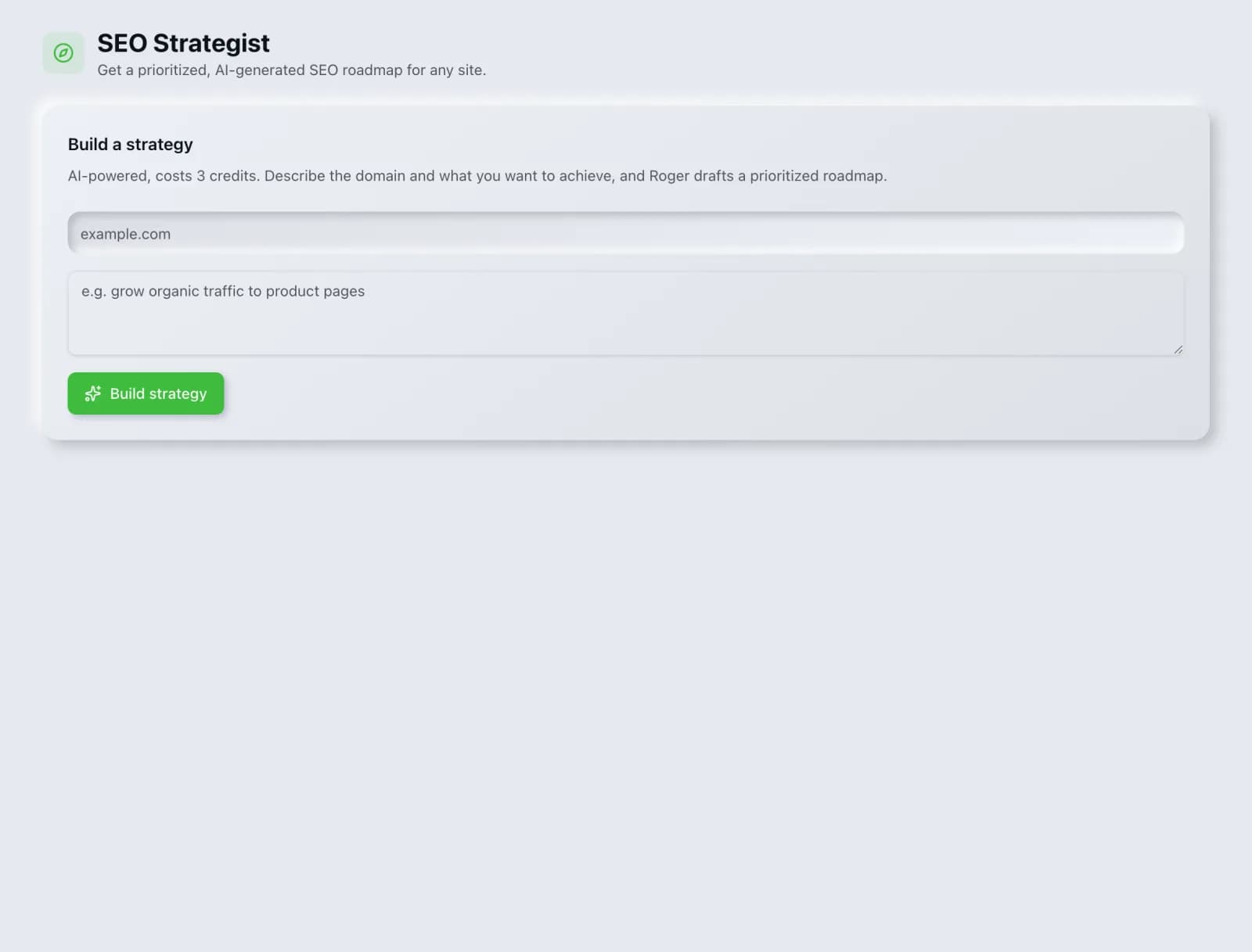
SEO Strategist before you run it: the inputs it asks for, and nothing else to wade through.
How it works
From input to insight in three steps.
Enter your URL or keyword
Point SEO Strategist at any page, domain or search term, yours or a competitor's.
SEO Roger analyzes it
We run the analysis with Claude across the major AI engines in seconds.
Get a prioritized report
Read a clear, ranked breakdown of exactly what to do next.
Related tools
More from AI Visibility.
What is SEO Strategist?
SEO Strategist takes your site and a goal and returns a prioritized roadmap: the strategic pillars to work on, each scored for priority, effort and impact, plus quick wins you can ship immediately and the KPIs to judge it by. It costs 3 credits per run.
How to use SEO Strategist
From signup to shipped fix, this is the whole loop.
- 1Create a free accountSign up in under a minute. No credit card is required, and your first site scan works without an account at all.
- 2Point SEO Strategist at your siteEnter the URL or domain you want to analyze. You can run it on your own site or on a competitor's.
- 3Let it pull the live dataSEO Strategist fetches the current state of the page or domain and runs its checks. Most runs finish in seconds.
- 4Read the ranked findingsResults come back ordered by impact rather than by count, so the issue costing you the most traffic is at the top, not buried under cosmetic warnings.
- 5Ship the fix, then re-runApply the recommended change, or let Roger AI draft it for you, then run the tool again to confirm the issue is resolved and track the improvement.
Why SEO Strategist matters
The common failure in SEO is not ignorance of what to do, it is having a list of forty possible actions and no defensible way to order them. Effort and impact pull in opposite directions, everything looks urgent, and teams default to whatever is easiest or whoever shouted last. A scored roadmap forces the ordering question to be answered explicitly, which is most of the value.
Search is no longer only Google. ChatGPT, Google AI Overviews, Perplexity, Gemini and Claude answer a growing share of queries by reading the same pages crawlers do, then citing a handful of sources. SEO Roger keeps both audiences in view: the classic SERP and the AI answer, from one workspace.
Who it's for
- Brands that want to be recommended by ChatGPT, Perplexity and AI Overviews, not just ranked in Google
- In-house SEOs who need visibility inside AI answer engines without stitching three tools together
- Agencies and consultants producing client-ready findings, fast
- Founders and marketers who want the fix, not just the metric
SEO Strategist in depth
Why effort and impact are scored separately
A single priority number hides the trade-off that actually drives decisions. Scoring effort and impact independently exposes four distinct groups: high impact and low effort, which you do this week; high impact and high effort, which needs planning and budget; low impact and low effort, which you do when you have a spare hour; and low impact and high effort, which you should decline. Most roadmaps fail because that fourth group never gets explicitly rejected.
Pillars rather than tasks
The roadmap is organized around strategic pillars such as technical health, content depth, authority and AI visibility, rather than as a flat task list. This matters because pillars have dependencies. Building content on a site that search engines cannot crawl properly is spending money on something that cannot pay back until the crawl problem is fixed. Seeing the pillars makes the sequencing obvious in a way a task list never does.
Naming the KPIs before the work starts
The plan specifies what to measure, and doing that in advance is a discipline rather than a formality. If you decide afterward how to judge the work, you will find a metric that went up. Committing to the measure beforehand means you can tell the difference between a strategy that worked and one that coincided with a good quarter, which is the only way the next plan gets better.
What it is and is not
This produces a strategic plan, not an execution engine. It tells you that your category pages are competing against each other and should be consolidated. It does not consolidate them. It is closest in value to a well-briefed consultant's first-week output, delivered in a couple of minutes, and like that output it needs a person to apply judgment about what fits your business, your resources and your market.
SEO Strategist questions, answered
How many credits does it cost?
3 credits per run, which covers analysing the site and generating the scored roadmap.
Can this replace an SEO consultant?
Not honestly, no. It produces a strong, structured starting point quickly and cheaply, which is genuinely useful when you have no plan at all. What it lacks is everything a consultant learns from your business: your margins, which products you actually want to sell, what your team can realistically ship, and the commercial context that decides whether a high-traffic opportunity is worth anything to you. Use it as a first draft that a person then argues with.
How specific are the recommendations?
Specific enough to act on, general enough that you should sanity-check them. It works from what it can observe about your site and the goal you state, so recommendations are grounded in your actual pages rather than generic advice. It cannot see your analytics, your revenue by page or your internal constraints, so anything depending on those needs your input.
How often should I regenerate the roadmap?
Quarterly at most, and only after you have executed a meaningful part of the previous one. Regenerating monthly produces a new plan before the last one has had time to work, which is a reliable way to do a little of everything and finish nothing.
Will following the plan guarantee more traffic?
No. SEO outcomes depend on your competitors, your authority, your market's search demand and algorithm changes nobody controls. A good plan improves your odds and stops you wasting effort in the wrong places. Anyone promising guaranteed traffic from a plan is selling something.
How does this differ from Roger AI?
Roger AI is a conversation with memory: you ask, it answers, you push back. SEO Strategist produces a single structured document in one pass. Use the strategist when you want a plan on paper, and Roger AI when you want to think through a specific problem.
Ready to try SEO Strategist?
Create a free account and run it in minutes, plus 55+ other SEO and AI-visibility tools in the same workspace.