AI Citation Tracker
Track whether AI answers cite your site.
For your target queries, see if AI answers actually cite your pages: the AI-era equivalent of rank tracking.
What you get
Everything AI Citation Tracker delivers, out of the box.
Per-query citation checks
Which page gets cited
Engine-by-engine results
Monitor over time
How it works
From input to insight in three steps.
Enter your URL or keyword
Point AI Citation Tracker at any page, domain or search term, yours or a competitor's.
SEO Roger analyzes it
We run the analysis with Claude across the major AI engines in seconds.
Get a prioritized report
Read a clear, ranked breakdown of exactly what to do next.
Related tools
More from AI Visibility.
What is AI Citation Tracker?
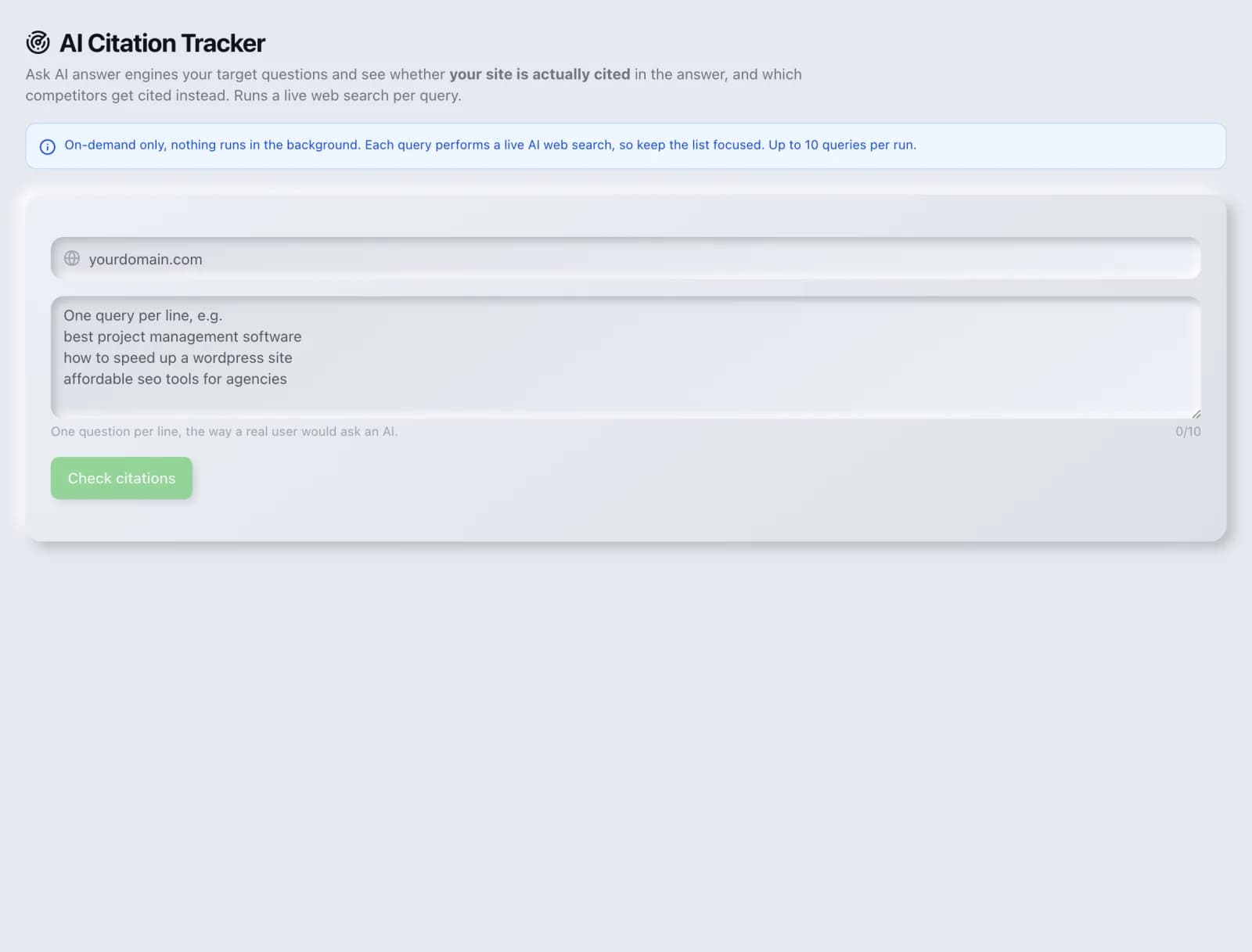
AI Citation Tracker checks whether AI answers actually cite your pages for the prompts you care about. You supply the queries, and it reports which of your URLs appear as sources, making it the AI-era counterpart to rank tracking. It costs 2 credits per query checked, up to 10 queries per run, so a quick three-prompt check is 6 credits rather than a flat fee.
How to use AI Citation Tracker
From signup to shipped fix, this is the whole loop.
- 1Create a free accountSign up in under a minute. No credit card is required, and your first site scan works without an account at all.
- 2Point AI Citation Tracker at your siteEnter the URL or domain you want to analyze. You can run it on your own site or on a competitor's.
- 3Let it pull the live dataAI Citation Tracker fetches the current state of the page or domain and runs its checks. Most runs finish in seconds.
- 4Read the ranked findingsResults come back ordered by impact rather than by count, so the issue costing you the most traffic is at the top, not buried under cosmetic warnings.
- 5Ship the fix, then re-runApply the recommended change, or let Roger AI draft it for you, then run the tool again to confirm the issue is resolved and track the improvement.
Why AI Citation Tracker matters
You cannot manage what you cannot see. Plenty of businesses are being recommended, or conspicuously not recommended, by AI assistants right now with no idea it is happening, because none of it appears in analytics: an AI-mediated recommendation often produces no referral at all. Checking directly is the only way to know where you stand.
Search is no longer only Google. ChatGPT, Google AI Overviews, Perplexity, Gemini and Claude answer a growing share of queries by reading the same pages crawlers do, then citing a handful of sources. SEO Roger keeps both audiences in view: the classic SERP and the AI answer, from one workspace.
Who it's for
- Brands that want to be recommended by ChatGPT, Perplexity and AI Overviews, not just ranked in Google
- In-house SEOs who need visibility inside AI answer engines without stitching three tools together
- Agencies and consultants producing client-ready findings, fast
- Founders and marketers who want the fix, not just the metric
AI Citation Tracker in depth
Choose prompts the way a customer would phrase them
The instinct is to test your brand name, but that mostly confirms the engine has heard of you. The valuable prompts are the ones a potential customer types before they know who you are: descriptions of a problem, requests for a recommendation in a category, comparisons between options. Those are the moments where being cited actually wins you something, and where absence actually costs you.
Why one check is a sample, not a verdict
This is the most important thing to understand about the numbers. Generative engines are non-deterministic: the same prompt can return different sources, in a different order, on different days, even with nothing changed on your site. A single check showing you absent is weak evidence. What matters is your citation rate across repeated checks over time, which is why the tool is built to be run repeatedly rather than once.
Being absent has a small number of causes
Work through them in order. Are the engines permitted to crawl you at all, which the AI Crawler Matrix answers in seconds and is the most common self-inflicted cause. Does content exist that actually answers the prompt. Is that content structured so a specific passage can be extracted, or does it meander toward the point. Is your brand described consistently enough elsewhere that an engine can connect it to the topic. Most absences resolve to one of these rather than to anything exotic.
What to do with a competitor citation
When a rival is cited and you are not, read the cited page rather than guessing. It is usually visible why: a direct answer near the top, specific figures, a clear structure, genuine depth on the exact question. That page is a concrete specification for what an engine wanted for that prompt, which is considerably more useful than general advice about being citable.
AI Citation Tracker questions, answered
How many credits does a run cost?
2 credits for each query checked, capped at 10 queries per run, so a run costs between 2 and 20 credits depending on how many prompts you check. It is metered per query rather than per run because each query triggers its own live search against an AI engine, which is what makes this tool more expensive to operate than a single database lookup. Queries that fail are not billed.
Why do results change between runs?
Because generative engines are non-deterministic by design, and their retrieval and ranking are proprietary and change without announcement. Variation between runs is expected behaviour rather than a fault. Track the rate across many checks rather than treating any single answer as the state of the world.
Does a citation send me traffic?
Sometimes, and considerably less than a search ranking would. Many AI answers satisfy the question without the user clicking anything, and some surfaces do not pass a referrer, so the visit may not be attributable even when it happens. The value is closer to brand visibility and influence at the moment of recommendation than to measurable sessions.
How many prompts should I track?
Start with ten to twenty that genuinely reflect how buyers describe their problem, and check them regularly rather than tracking two hundred once. Because you need repetition to see through the variance, depth of history beats breadth of coverage here.
Can I make an engine cite me?
No. You can make your content substantially more likely to be used, by being crawlable, factual, specific, well-structured and genuinely authoritative on the subject. Nobody can compel a citation, and any product claiming to guarantee one is misrepresenting how these systems work.
How does this differ from AI Visibility?
AI Visibility gives you a broad assessment of how well positioned your site is across AI engines. Citation Tracker answers the narrow, concrete question of whether you appeared for specific prompts. Use the first to understand your general standing and this to monitor the queries that matter commercially.
Ready to try AI Citation Tracker?
Create a free account and run it in minutes, plus 55+ other SEO and AI-visibility tools in the same workspace.