Crawler Governance
Control which AI bots crawl your site.
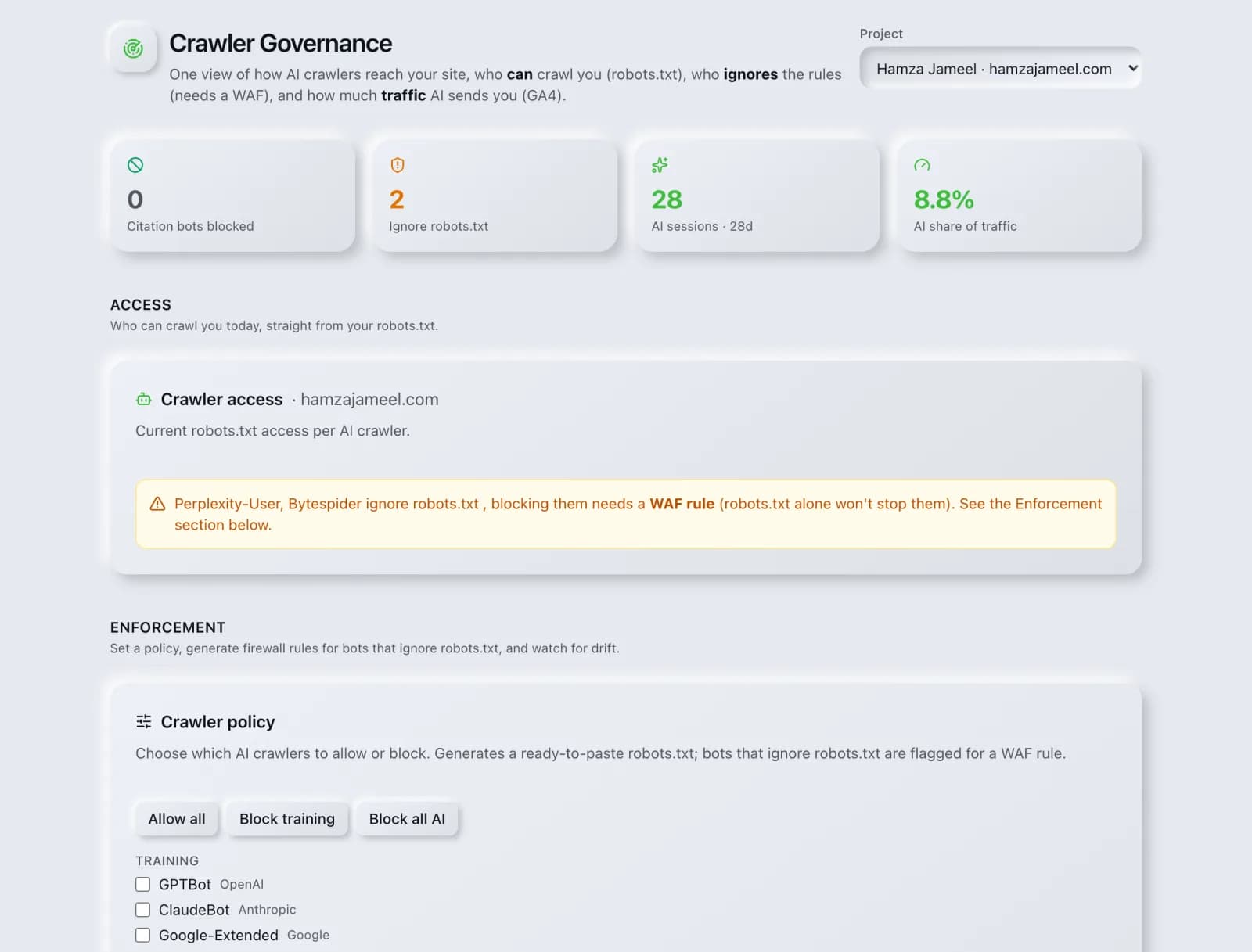
Observe AI crawler access and AI-referral traffic, set a policy, and synthesize the robots.txt / WAF rules to enforce it.
What you get
Everything Crawler Governance delivers, out of the box.
AI crawler access & referral traffic
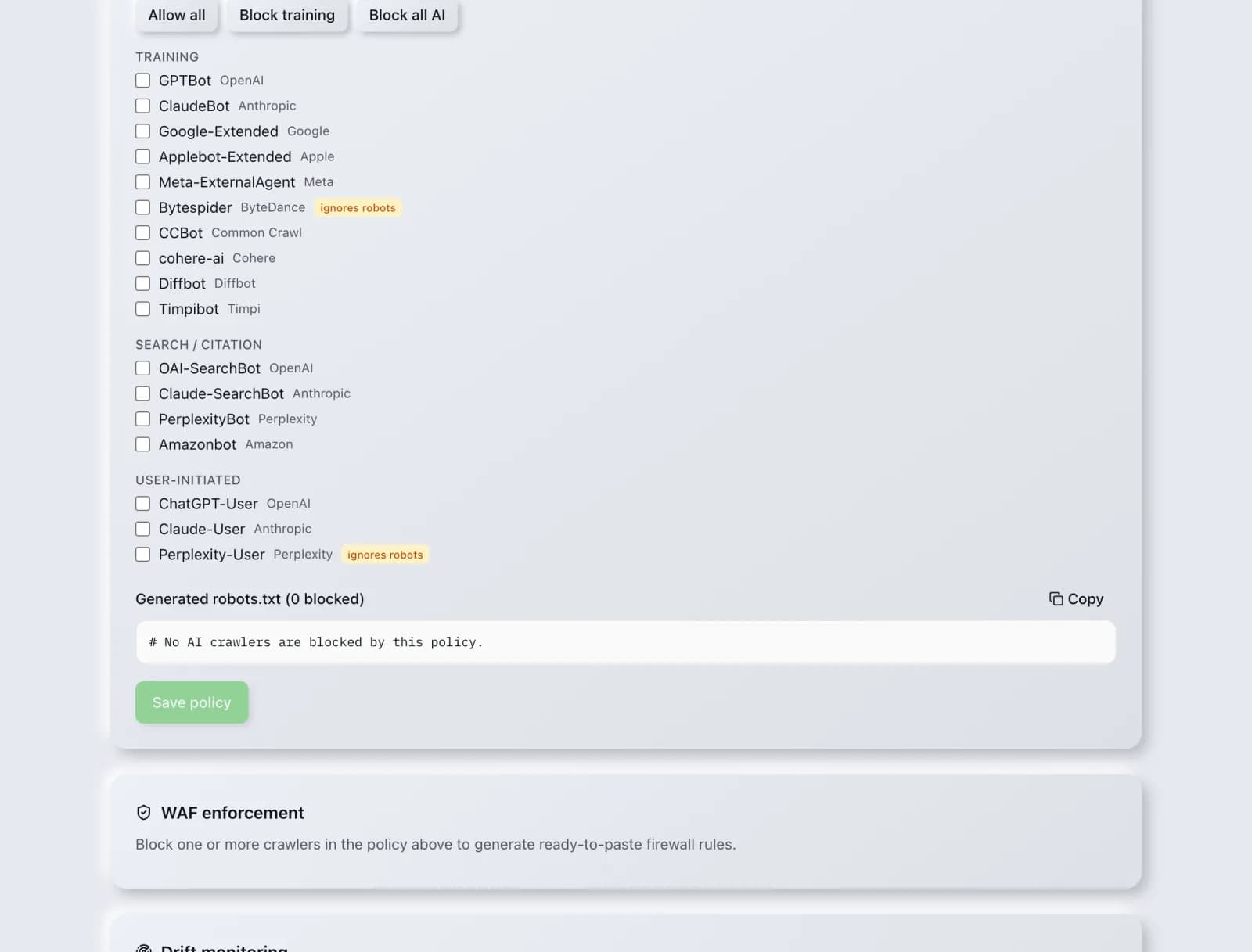
Policy → robots.txt synthesis
Cloudflare WAF rules
Drift monitoring
Further down the screen
The rest of what Crawler Governance puts in front of you, from the same session.
How it works
From input to insight in three steps.
Enter your URL or keyword
Point Crawler Governance at any page, domain or search term, yours or a competitor's.
SEO Roger analyzes it
We run the analysis with Claude across the major AI engines in seconds.
Get a prioritized report
Read a clear, ranked breakdown of exactly what to do next.
Related tools
More from AI Visibility.
What is Crawler Governance?
Crawler Governance is the full workflow for controlling AI crawler access: observe which crawlers are reaching your site and what AI referral traffic you receive, decide a policy, then generate the robots.txt and firewall rules that enforce it. It is free on every plan.
How to use Crawler Governance
From signup to shipped fix, this is the whole loop.
- 1Create a free accountSign up in under a minute. No credit card is required, and your first site scan works without an account at all.
- 2Point Crawler Governance at your siteEnter the URL or domain you want to analyze. You can run it on your own site or on a competitor's.
- 3Let it pull the live dataCrawler Governance fetches the current state of the page or domain and runs its checks. Most runs finish in seconds.
- 4Read the ranked findingsResults come back ordered by impact rather than by count, so the issue costing you the most traffic is at the top, not buried under cosmetic warnings.
- 5Ship the fix, then re-runApply the recommended change, or let Roger AI draft it for you, then run the tool again to confirm the issue is resolved and track the improvement.
Why Crawler Governance matters
Most sites have no deliberate position on AI crawlers at all. Access is whatever a plugin default, an inherited robots file or a CDN setting happens to produce, which means a consequential decision about who may use your content is being made by accident. Governance means deciding on purpose, writing it down, and being able to verify it is still true next quarter.
Search is no longer only Google. ChatGPT, Google AI Overviews, Perplexity, Gemini and Claude answer a growing share of queries by reading the same pages crawlers do, then citing a handful of sources. SEO Roger keeps both audiences in view: the classic SERP and the AI answer, from one workspace.
Who it's for
- Brands that want to be recommended by ChatGPT, Perplexity and AI Overviews, not just ranked in Google
- In-house SEOs who need visibility inside AI answer engines without stitching three tools together
- Agencies and consultants producing client-ready findings, fast
- Founders and marketers who want the fix, not just the metric
Crawler Governance in depth
Observe before you decide
Setting policy without data produces rules based on assumption. The observation step shows which crawlers actually reach your site and what referral traffic arrives from AI surfaces, which frequently contradicts expectations in both directions: crawlers you assumed were blocked are fetching freely, and engines you assumed were sending traffic are sending none. Decide after looking, not before.
Policy is a business decision, not a technical one
The right policy depends on what your content is worth to you and how it earns. A software company whose blog exists to generate awareness usually wants maximum AI visibility. A publisher whose subscriptions depend on people reading the article on the page has a genuinely different interest. A site with paywalled or licensed material may have contractual obligations. The tool does not pick for you; it makes the choice explicit and then enforces whatever you choose.
Two layers of enforcement, doing different jobs
robots.txt is a request that well-behaved crawlers honour voluntarily, and it is the correct tool for communicating intent to established, compliant bots. A firewall rule is enforcement that applies regardless of cooperation, and it is what you need if you genuinely want to stop something rather than ask it to stop. Most sites need the first. Sites with real commercial exposure need both, and should understand that only the second one is binding.
Drift is the reason to monitor
Policies decay silently. A plugin update rewrites robots.txt, a CDN enables a new managed bot ruleset, a developer adds a blanket disallow while debugging and forgets it, an agency hands over a site with rules nobody documented. Scheduled monitoring exists because the failure mode here is not making a wrong decision, it is a right decision quietly ceasing to be in effect months later.
Crawler Governance questions, answered
Does Crawler Governance cost credits?
No. It is free on every plan.
How is this different from the AI Crawler Matrix?
The matrix is the read-only snapshot: which crawlers are currently allowed or blocked. Governance is the full loop: observe traffic and access, set a policy, generate the rules to enforce it, and monitor for drift. Use the matrix for a quick check and governance when you want a documented, enforced position.
Will blocking AI crawlers protect my content from being used?
Partially, and it is important to be realistic. Blocking prevents compliant crawlers from fetching your pages going forward. It does not remove content already collected, it does not affect content republished elsewhere, and it does not stop actors who ignore robots rules unless you enforce at the firewall. It reduces exposure rather than eliminating it.
Can I allow some engines and block others?
Yes, and it is often the sensible policy. Crawler rules are set per user agent, so you can allow the engines where citation is valuable to you and block the ones you would rather not feed. The generated rules handle each agent separately.
Does blocking AI crawlers affect my Google rankings?
Not if the rules are written correctly, because the AI-specific agents are distinct from Googlebot. The risk is a badly written blanket rule that catches Googlebot as a side effect, which would be seriously damaging. Generating the rules rather than hand-writing them is largely about avoiding that error.
How often should I check for drift?
Quarterly for most sites, and immediately after any platform migration, CDN change, security plugin installation or agency handover. Those are the events that silently rewrite crawler rules.
Ready to try Crawler Governance?
Create a free account and run it in minutes, plus 55+ other SEO and AI-visibility tools in the same workspace.