Entity SEO Analyzer
Make search & AI engines know exactly who you are.
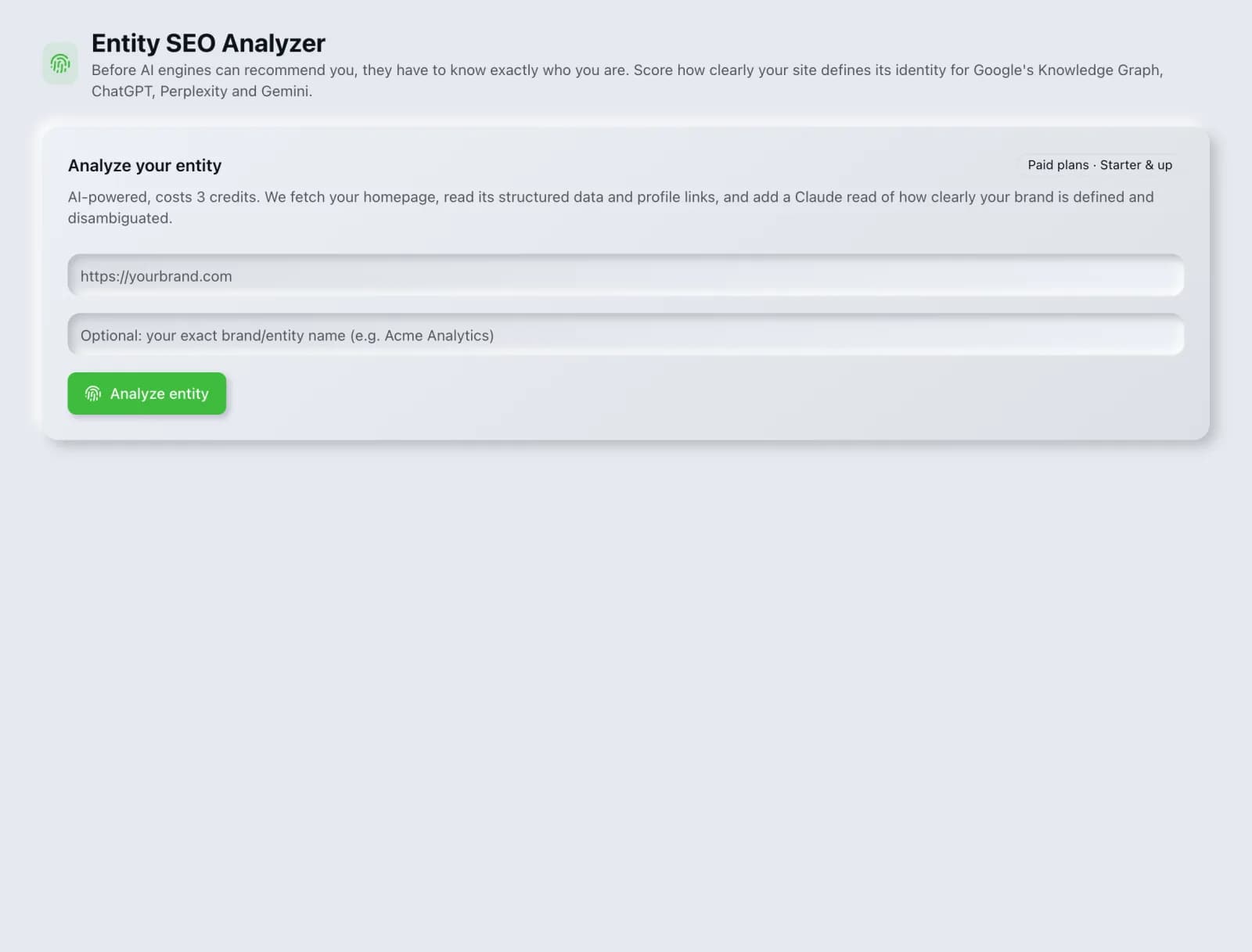
Before an AI engine can recommend your brand, it has to understand you as an unambiguous entity. We fetch your homepage and score the signals that make you legible to Google's Knowledge Graph, ChatGPT, Perplexity and Gemini: Organization schema and its completeness, sameAs links to authoritative profiles, knowledge-graph references (Wikipedia, Wikidata, Crunchbase), an About page, people/author entities, name consistency and contact/NAP, then add a Roger read of entity clarity and disambiguation with prioritized fixes.
What you get
Everything Entity SEO Analyzer delivers, out of the box.
Entity Clarity score + grade
Organization schema & sameAs audit
Knowledge-panel readiness
Prioritized, site-specific fixes
How it works
From input to insight in three steps.
Enter your URL or keyword
Point Entity SEO Analyzer at any page, domain or search term, yours or a competitor's.
SEO Roger analyzes it
We run the analysis with Roger AI across the major AI engines in seconds.
Get a prioritized report
Read a clear, ranked breakdown of exactly what to do next.
Related tools
More from AI Visibility.
What is Entity SEO Analyzer?
Entity SEO Analyzer scores how clearly search engines and AI systems can identify your brand as a distinct, unambiguous entity. It fetches your homepage and grades Organization schema and its completeness, sameAs links to authoritative profiles, references to knowledge bases such as Wikipedia and Wikidata, the presence of an About page, people and author entities, name consistency and contact details, then adds an AI assessment of entity clarity with prioritized fixes. It costs 3 credits and is available on Starter, Pro and Agency plans.
How to use Entity SEO Analyzer
From signup to shipped fix, this is the whole loop.
- 1Create a free accountSign up in under a minute. No credit card is required, and your first site scan works without an account at all.
- 2Point Entity SEO Analyzer at your siteEnter the URL or domain you want to analyze. You can run it on your own site or on a competitor's.
- 3Let it pull the live dataEntity SEO Analyzer fetches the current state of the page or domain and runs its checks. Most runs finish in seconds.
- 4Read the ranked findingsResults come back ordered by impact rather than by count, so the issue costing you the most traffic is at the top, not buried under cosmetic warnings.
- 5Ship the fix, then re-runApply the recommended change, or let Roger AI draft it for you, then run the tool again to confirm the issue is resolved and track the improvement.
Why Entity SEO Analyzer matters
Before any engine can recommend your brand, it has to be confident about which brand you are. Search engines and AI assistants both work with entities rather than strings, and if your business name is ambiguous, shared with a larger company, or described inconsistently across the web, the engine cannot connect the signals that should be accumulating in your favour. Entity clarity is the prerequisite that most brands never explicitly address.
Search is no longer only Google. ChatGPT, Google AI Overviews, Perplexity, Gemini and Claude answer a growing share of queries by reading the same pages crawlers do, then citing a handful of sources. SEO Roger keeps both audiences in view: the classic SERP and the AI answer, from one workspace.
Who it's for
- Brands that want to be recommended by ChatGPT, Perplexity and AI Overviews, not just ranked in Google
- In-house SEOs who need visibility inside AI answer engines without stitching three tools together
- Agencies and consultants producing client-ready findings, fast
- Founders and marketers who want the fix, not just the metric
Entity SEO Analyzer in depth
Why sameAs links do the heavy lifting
The sameAs property in your Organization schema lists the authoritative profiles that represent the same entity: your LinkedIn company page, your Wikidata item, your Crunchbase entry, your verified social accounts. It is how you tell an engine that the business on this website and the business on those profiles are the same organization. Without it, an engine has to infer the connection, and inference fails exactly when your name is not unique.
Name consistency is unglamorous and decisive
If you are one name in your schema, a slightly different name in your footer, a third variation on LinkedIn and a fourth on your invoices, you have fragmented your identity across four partial entities instead of building one strong one. Picking a single canonical name and using it everywhere, including punctuation and legal suffixes, is among the cheapest high-value things on this list, and one of the most commonly skipped.
Knowledge base references and why they matter disproportionately
Wikipedia and Wikidata carry unusual weight because they are structured, heavily cross-referenced and widely used as reference data. A Wikidata item is far more attainable than a Wikipedia article, which has strict notability requirements you may not meet. Being present in structured public knowledge bases gives engines a stable anchor for your entity that does not depend on your own site.
People are entities too
Author and executive entities feed back into organizational credibility. Named authors with real credentials, linked to their own profiles and consistently attributed, support the experience and expertise signals that both search quality guidelines and AI systems weigh. Content published under a generic admin account or no byline at all forfeits this entirely, which is a common and unnecessary loss on otherwise credible sites.
Entity SEO Analyzer questions, answered
How many credits does it cost, and which plans include it?
3 credits per run, on the Starter, Pro and Agency plans. It is not available on the free plan.
What is an entity in this context?
A specific thing an engine can identify and hold facts about, rather than a piece of text. Your company is an entity; your company name is a string that might refer to several entities. Search and AI systems reason about entities so they can connect information from many sources to the same subject. Entity SEO is the work of making sure they connect all of yours to you.
Do I need a Wikipedia page?
No, and most businesses will not qualify, since Wikipedia's notability requirements are genuinely demanding and attempting to create a page you do not qualify for wastes time and can backfire. A Wikidata item is a much more realistic target and delivers a large share of the structured-reference benefit.
Will this get me a Google Knowledge Panel?
It improves the signals that make one possible, but no tool can promise a knowledge panel. Google decides independently based on how confident it is about the entity and how much corroboration exists across the web. Complete schema, consistent naming and authoritative profiles are the groundwork; the decision is Google's.
How does this differ from Reputation SEO?
Entity SEO answers whether engines know who you are. Reputation SEO answers whether they have reason to trust you. Identity comes first: trust signals attached to an entity an engine cannot confidently identify do not accumulate properly.
How often should I run it?
After any rebrand, name change, site redesign or new schema deployment, and otherwise a couple of times a year. Entity signals change slowly, and there is little to learn from running it monthly on a stable site.
Ready to try Entity SEO Analyzer?
Create a free account and run it in minutes, plus 59+ other SEO and AI-visibility tools in the same workspace.