GEO Content Analyzer
Score any page for how citable it is to AI answer engines.
Paste a URL and get a GEO Readiness score for how well that page is optimized to be cited by generative engines (ChatGPT, Perplexity, Google AI Overviews, Gemini, Claude). We fetch the page and measure the on-page signals that drive AI citations: direct answers, statistics, sources, quotations, structure, schema, freshness and AI crawlability, then add a Roger quality read with prioritized, page-specific fixes.
What you get
Everything GEO Content Analyzer delivers, out of the box.
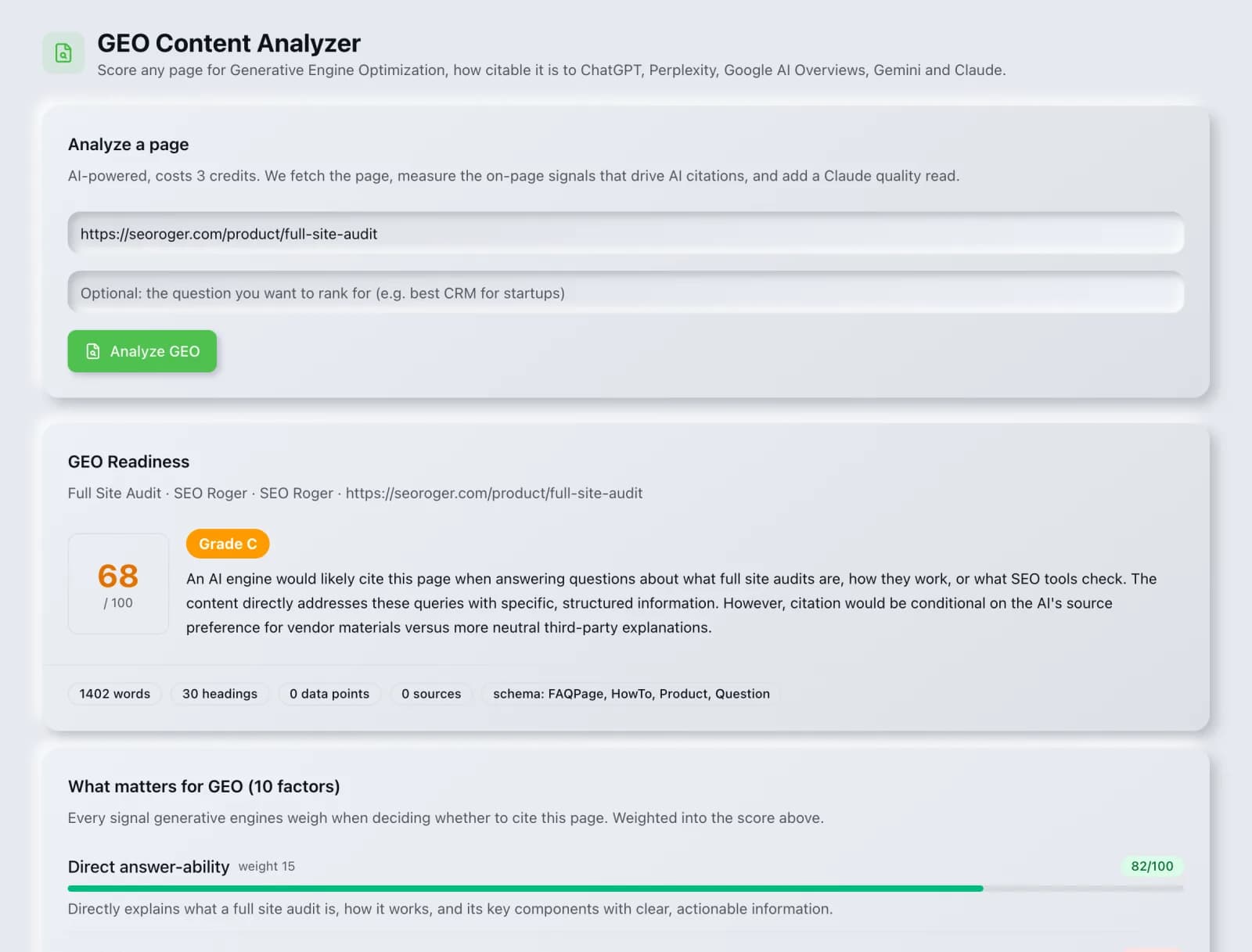
GEO Readiness score + grade
10-factor citability breakdown
Prioritized, page-specific fixes
AI verdict + quotable snippets
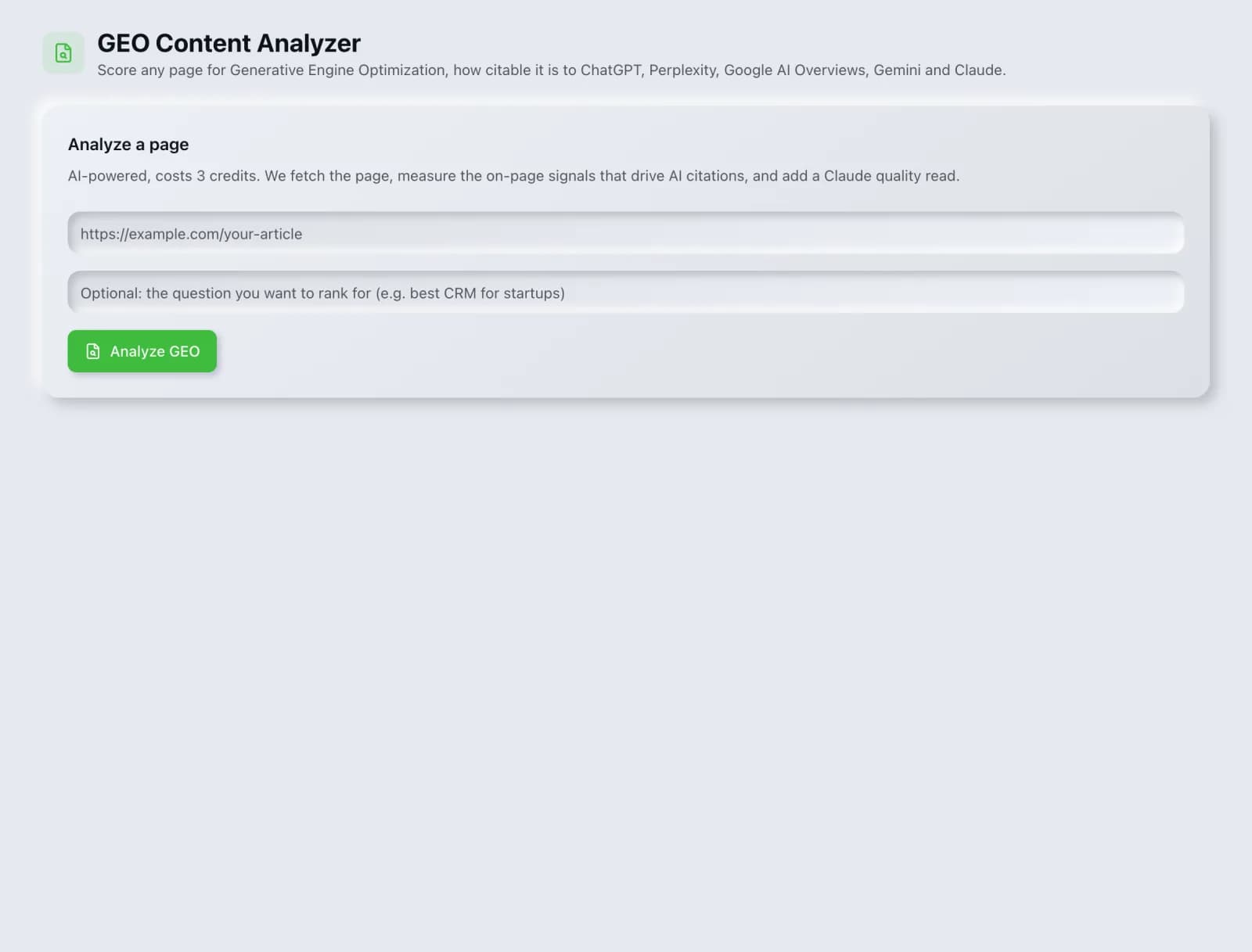
Where you start
GEO Content Analyzer before you run it: the inputs it asks for, and nothing else to wade through.
How it works
From input to insight in three steps.
Enter your URL or keyword
Point GEO Content Analyzer at any page, domain or search term, yours or a competitor's.
SEO Roger analyzes it
We run the analysis with Roger AI across the major AI engines in seconds.
Get a prioritized report
Read a clear, ranked breakdown of exactly what to do next.
Related tools
More from AI Visibility.
What is GEO Content Analyzer?
The GEO Content Analyzer scores a single page on how likely generative engines are to cite it. It fetches the live URL, measures ten factors that drive AI citation, from direct answer-ability and statistics to schema, freshness and whether AI crawlers are even allowed, then blends that with an AI quality read into one GEO Readiness score with prioritized, page-specific fixes. It costs 3 credits per analysis.
How to use GEO Content Analyzer
From signup to shipped fix, this is the whole loop.
- 1Create a free accountSign up in under a minute. No credit card is required, and your first site scan works without an account at all.
- 2Point GEO Content Analyzer at your siteEnter the URL or domain you want to analyze. You can run it on your own site or on a competitor's.
- 3Let it pull the live dataGEO Content Analyzer fetches the current state of the page or domain and runs its checks. Most runs finish in seconds.
- 4Read the ranked findingsResults come back ordered by impact rather than by count, so the issue costing you the most traffic is at the top, not buried under cosmetic warnings.
- 5Ship the fix, then re-runApply the recommended change, or let Roger AI draft it for you, then run the tool again to confirm the issue is resolved and track the improvement.
Why GEO Content Analyzer matters
Generative Engine Optimization is the difference between a page that ranks and a page that gets quoted. Answer engines do not cite the best page, they cite the most liftable one: the page that answers directly, backs claims with specifics, and is structured so a clean, self-contained block can be extracted. That is a measurable property of a page, and this tool measures it.
Search is no longer only Google. ChatGPT, Google AI Overviews, Perplexity, Gemini and Claude answer a growing share of queries by reading the same pages crawlers do, then citing a handful of sources. SEO Roger keeps both audiences in view: the classic SERP and the AI answer, from one workspace.
Who it's for
- Brands that want to be recommended by ChatGPT, Perplexity and AI Overviews, not just ranked in Google
- In-house SEOs who need visibility inside AI answer engines without stitching three tools together
- Agencies and consultants producing client-ready findings, fast
- Founders and marketers who want the fix, not just the metric
GEO Content Analyzer in depth
The factors that actually drive citation
The score weighs direct answer-ability, statistics and quantified claims, citations and outbound sourcing, structure and extractability, schema, authority signals, comprehensiveness, quotations, freshness and AI crawlability. Research into generative engine behaviour consistently finds that adding statistics, citations and quotations moves citation rates more than most classic on-page tweaks, which is why those carry real weight here.
Why crawlability is scored at all
It is the precondition. If robots.txt blocks the crawlers that feed answer engines, nothing else on the page matters, because it can never be cited. The analyzer checks your robots rules for the major AI bots and drops the score sharply when the heavyweight citation crawlers are blocked, since that is a total loss rather than a weakness.
What the AI read adds, and how it fails safely
On top of the deterministic checks, the page text is sent to Roger for a judgement on answer-ability, authority and comprehensiveness, plus the snippets an engine would most likely quote. If that call is unavailable the tool does not fail: it falls back to deterministic estimates for those three factors, flags that the AI read was unavailable, and the structural score stands unchanged.
Page-level tool, site-level strategy
This analyzes one URL in depth. For a site-wide plan use the GEO Specialist, and pair it with Entity SEO and Reputation SEO, which cover the two things a page cannot fix on its own: whether the engine knows who you are, and whether it has reason to trust you enough to recommend you.
GEO Content Analyzer questions, answered
What is GEO in SEO?
GEO stands for Generative Engine Optimization: optimizing content so generative AI engines cite it in their answers. It overlaps with SEO on fundamentals such as crawlability and clarity, but weights direct answers, sourced claims, extractable structure and schema far more heavily, because the output is a synthesized answer rather than a list of links.
How is GEO different from AEO?
AEO, answer engine optimization, targets direct answers inside search itself, such as featured snippets and People Also Ask. GEO targets being cited by generative engines such as ChatGPT and Perplexity. The techniques rhyme, but GEO puts more emphasis on being quotable and verifiable, and on entity clarity, because the engine is deciding which sources to trust rather than which page to rank.
How much does the GEO Content Analyzer cost?
3 credits per page analyzed, which covers fetching and parsing the page plus the AI quality assessment.
How do I make my content more citable by AI?
Answer the question directly in the first lines of the relevant section rather than building up to it. Support claims with specific numbers, dates and named sources. Use clear headings phrased as the questions people ask, with short paragraphs and lists that can be lifted whole. Add Article or FAQ schema, show a visible updated date, and make sure AI crawlers are not blocked.
What score should I aim for?
Above 70 is a solid position and above 85 is strong, but the ranked fix list matters more than the number. A page scoring 60 with one critical crawlability block fixed will outperform a page polished from 78 to 82, which is why the report orders recommendations by impact rather than presenting the score alone.
Does this work for any website?
Yes, on any publicly reachable page, on any platform. The analyzer fetches the live URL the way a crawler would, so nothing needs to be installed and you can analyze competitor pages to see why they are being cited instead of you.
Ready to try GEO Content Analyzer?
Create a free account and run it in minutes, plus 59+ other SEO and AI-visibility tools in the same workspace.