GEO Specialist
Get cited by ChatGPT, Perplexity & Google AI.
A Generative Engine Optimization plan: what makes your content citable by AI engines, per-engine tactics (ChatGPT, Perplexity, Google AI, Claude), the prompts you should be cited for, and quick wins to earn AI mentions.
What you get
Everything GEO Specialist delivers, out of the box.
AI citability score
Per-engine tactics
Citability-factor audit
Prompt/content gaps
How it works
From input to insight in three steps.
Enter your URL or keyword
Point GEO Specialist at any page, domain or search term, yours or a competitor's.
SEO Roger analyzes it
We run the analysis with Roger AI across the major AI engines in seconds.
Get a prioritized report
Read a clear, ranked breakdown of exactly what to do next.
Related tools
More from AI Visibility.
What is GEO Specialist?
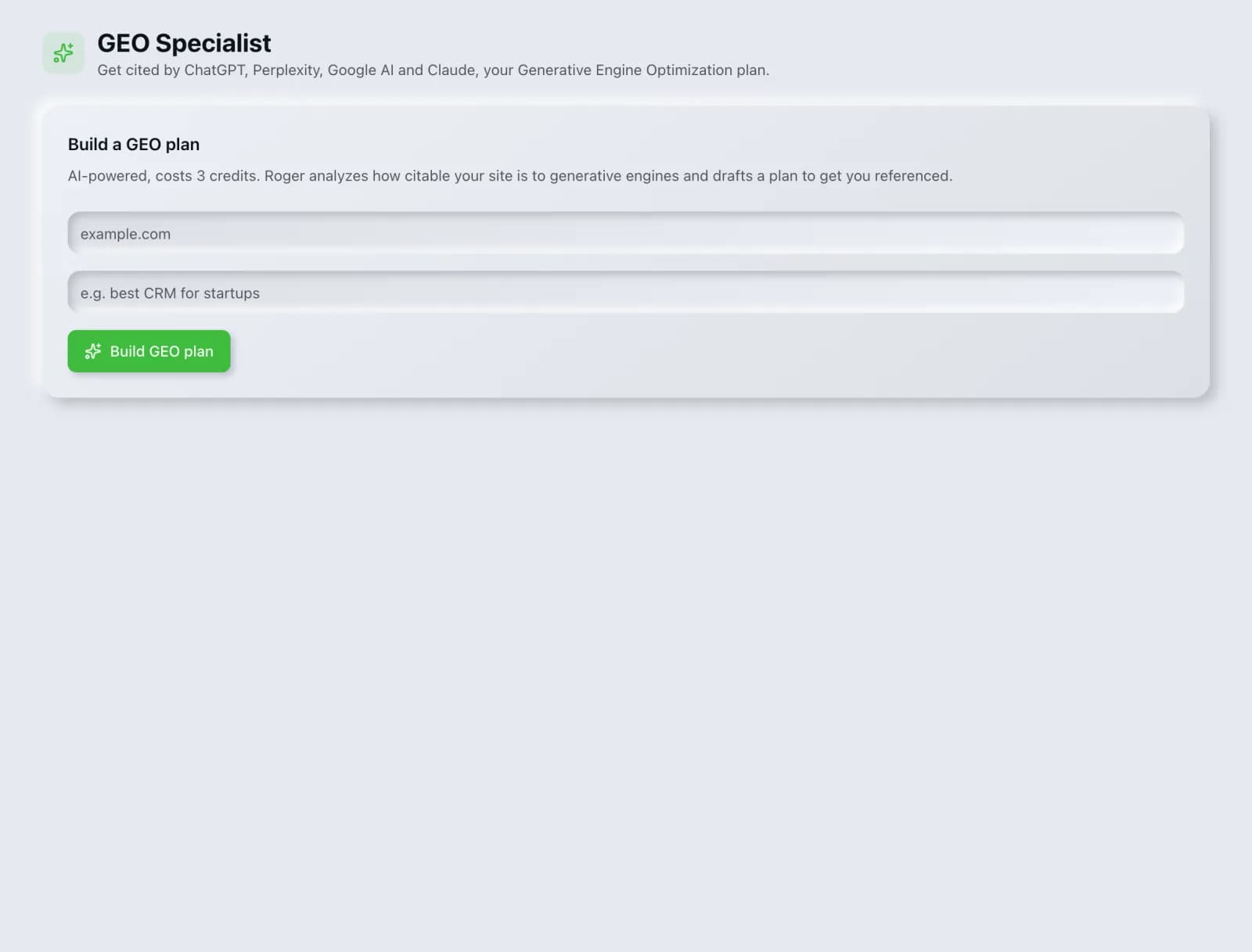
GEO Specialist produces a Generative Engine Optimization plan: what makes your content citable by AI engines, tactics specific to each major engine, the prompts you should be appearing for, and quick wins to earn AI mentions. It costs 3 credits per run.
How to use GEO Specialist
From signup to shipped fix, this is the whole loop.
- 1Create a free accountSign up in under a minute. No credit card is required, and your first site scan works without an account at all.
- 2Point GEO Specialist at your siteEnter the URL or domain you want to analyze. You can run it on your own site or on a competitor's.
- 3Let it pull the live dataGEO Specialist fetches the current state of the page or domain and runs its checks. Most runs finish in seconds.
- 4Read the ranked findingsResults come back ordered by impact rather than by count, so the issue costing you the most traffic is at the top, not buried under cosmetic warnings.
- 5Ship the fix, then re-runApply the recommended change, or let Roger AI draft it for you, then run the tool again to confirm the issue is resolved and track the improvement.
Why GEO Specialist matters
A growing share of research now starts in a generative AI assistant rather than a search box, and those systems recommend a small number of sources rather than listing ten links. Being one of the sources an engine draws on is a different competition from ranking, with different mechanics, and it is currently far less contested than conventional search.
Search is no longer only Google. ChatGPT, Google AI Overviews, Perplexity, Gemini and Claude answer a growing share of queries by reading the same pages crawlers do, then citing a handful of sources. SEO Roger keeps both audiences in view: the classic SERP and the AI answer, from one workspace.
Who it's for
- Brands that want to be recommended by ChatGPT, Perplexity and AI Overviews, not just ranked in Google
- In-house SEOs who need visibility inside AI answer engines without stitching three tools together
- Agencies and consultants producing client-ready findings, fast
- Founders and marketers who want the fix, not just the metric
GEO Specialist in depth
Citation is not ranking
Generative engines synthesize an answer from several sources and may cite some of them. There is no position one. You are either drawn on or you are not, and the pool is small, often three to five sources for a given answer. This makes the competition less about incremental position and more about whether your content is structured to be usable as a source at all.
What makes content citable
The patterns that get content used are consistent across engines: clear factual statements that can be lifted without distortion, specific figures and dates rather than vague claims, sourced assertions, direct answers to questions, and content that is genuinely current. Marketing prose that carefully avoids committing to anything specific is almost useless to a system trying to assemble a factual answer, because there is nothing in it to quote.
Engines behave differently
They do not work the same way and should not be treated as one target. Some lean heavily on live retrieval and cite recent web pages. Some lean on training data, where recency matters far less and being widely referenced across the web matters far more. Some blend both. This is why one plan for all engines underperforms, and why the tool separates tactics per engine.
Being mentioned elsewhere matters as much as your own pages
This is the part most GEO advice underplays. Engines that draw on training data are influenced by how your brand is described across the web, not only on your own site. Being described consistently and accurately on third-party sites, review platforms and industry publications shapes what an engine believes about you. You cannot optimize your way to that with on-page work alone, which is why Entity SEO and Reputation SEO sit alongside this tool.
GEO Specialist questions, answered
How many credits does it cost?
3 credits per run.
Can you guarantee I will be cited by ChatGPT or Perplexity?
No, and treat any tool claiming otherwise with suspicion. These systems are non-deterministic, their retrieval and ranking are proprietary and change without notice, and the same prompt can return different sources on different days. What is achievable is making your content substantially more citable: structured, factual, specific and current. That improves your odds without controlling the outcome.
How do I know whether it is working?
Run the AI Citation Tracker on the prompts you care about, repeatedly. Because responses vary between runs, a single check is a sample rather than a verdict, and the meaningful signal is your citation rate across many checks over time rather than any individual answer.
Do I need to block or allow AI crawlers for this?
Allow them, if citation is the goal. An engine cannot cite content it was never permitted to fetch. Use the AI Crawler Matrix to confirm the engines you care about are not blocked, because this is a common and entirely self-inflicted reason for absence from AI answers.
Is GEO different enough from SEO to need separate work?
It shares a large foundation. Crawlable, well-structured, genuinely authoritative content serves both. The differences that justify separate attention are the emphasis on extractable factual passages, the weight given to third-party mentions for engines drawing on training data, and the fact that measurement works completely differently.
How quickly do changes show up in AI answers?
It varies by engine and is much less predictable than search. Engines doing live retrieval can reflect a change within days of recrawling. Engines relying on training data may not reflect it until a future training cycle, which can be many months. Set expectations accordingly.
Ready to try GEO Specialist?
Create a free account and run it in minutes, plus 59+ other SEO and AI-visibility tools in the same workspace.