HTTP Status Checker
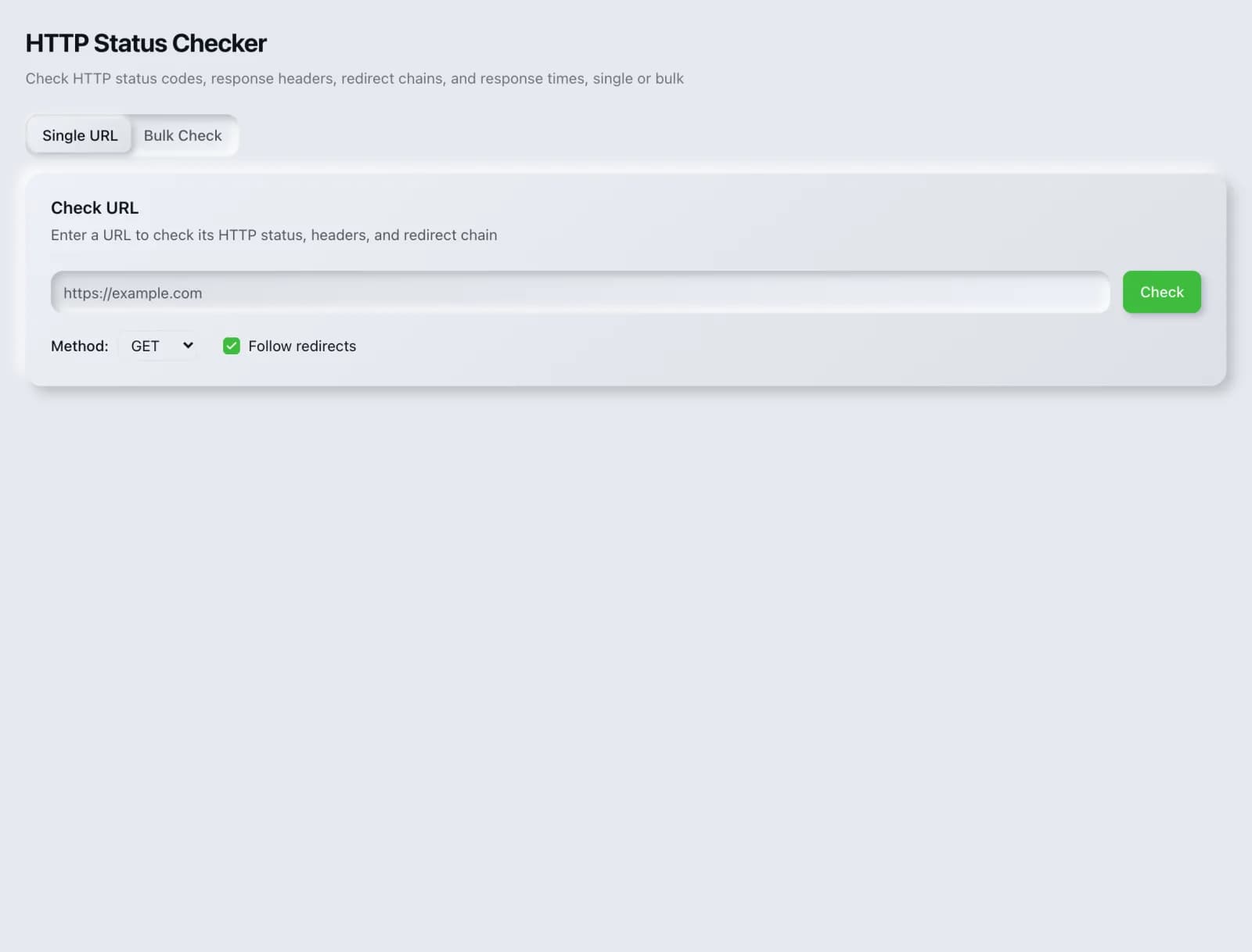
Check status codes for one or many URLs.
Bulk-check HTTP status codes and redirect chains to catch 404s, redirect loops and broken links.
What you get
Everything HTTP Status Checker delivers, out of the box.
Single or bulk URLs
Redirect chain trace
Response headers
Free to use
How it works
From input to insight in three steps.
Enter your URL or keyword
Point HTTP Status Checker at any page, domain or search term, yours or a competitor's.
SEO Roger analyzes it
We run the analysis with our crawler and validators in seconds.
Get a prioritized report
Read a clear, ranked breakdown of exactly what to do next.
Related tools
More from Technical SEO.
What is HTTP Status Checker?
The HTTP Status Checker takes one URL or a list and reports the status code each returns, following redirect chains to their final destination so you can see every hop rather than only the endpoint. It is free on every plan.
How to use HTTP Status Checker
From signup to shipped fix, this is the whole loop.
- 1Create a free accountSign up in under a minute. No credit card is required, and your first site scan works without an account at all.
- 2Point HTTP Status Checker at your siteEnter the URL or domain you want to analyze. You can run it on your own site or on a competitor's.
- 3Let it pull the live dataHTTP Status Checker fetches the current state of the page or domain and runs its checks. Most runs finish in seconds.
- 4Read the ranked findingsResults come back ordered by impact rather than by count, so the issue costing you the most traffic is at the top, not buried under cosmetic warnings.
- 5Ship the fix, then re-runApply the recommended change, or let Roger AI draft it for you, then run the tool again to confirm the issue is resolved and track the improvement.
Why HTTP Status Checker matters
Status codes are the ground truth of what a server tells a crawler, and they are invisible in a browser, which quietly follows redirects and renders whatever arrives. A page can 302 through three hops before landing somewhere, or return a 200 with an error message on it, and look completely normal to you while being handled quite differently by a search engine.
Search is no longer only Google. ChatGPT, Google AI Overviews, Perplexity, Gemini and Claude answer a growing share of queries by reading the same pages crawlers do, then citing a handful of sources. SEO Roger keeps both audiences in view: the classic SERP and the AI answer, from one workspace.
Who it's for
- In-house SEOs who need crawling, indexing and structured data without stitching three tools together
- Agencies and consultants producing client-ready findings, fast
- Founders and marketers who want the fix, not just the metric
HTTP Status Checker in depth
The codes that actually matter
200 means the page was served. 301 is a permanent redirect that passes signals to the destination. 302 is temporary and keeps the original indexed. 404 means not found, which is correct and healthy for a page that genuinely does not exist. 410 means permanently gone and is processed faster than 404. 500 means the server failed, and sustained 500s on important URLs are the most urgent thing on this list because they can cost you indexing.
Soft 404s are the invisible problem
A soft 404 is a missing page that returns 200 alongside a friendly not-found message. To a person it is obviously an error page; to a crawler it is a valid page with thin content, so it stays in the index, gets crawled repeatedly and dilutes your quality signals. This is why checking codes matters more than checking that a page loads: the two questions have different answers.
Following the whole chain
Seeing only the final code hides the interesting part. A URL that reaches a 200 after four redirects has a problem worth fixing even though the destination is fine, because each hop costs crawl budget and a little value, and a chain that long usually indicates rules layered over years. Chains also break in ways single-hop checks never reveal, such as a middle hop dropping query parameters.
When to run it in bulk
Bulk checking earns its keep at specific moments: after a migration, where it is the fastest way to verify every old URL lands correctly; when auditing a backlink profile, to find valuable inbound links pointing at broken pages; and after a bulk content change, to catch URLs that silently stopped resolving. Outside those moments, individual checks are usually enough.
HTTP Status Checker questions, answered
Does it cost credits?
No. Status checks are free on every plan.
Is a 404 bad for SEO?
Not inherently. A 404 for a page that genuinely does not exist is correct behaviour and every site has them. They become a problem when they are on URLs that have inbound links or that used to rank, since that value is being discarded. Fix those by redirecting to a genuinely equivalent page; leave the rest as 404s.
What is the difference between 404 and 410?
404 means not found, which leaves open the possibility it will return. 410 means permanently gone. Search engines generally drop 410 URLs from the index faster. Use 410 when you have deliberately removed something for good and want it gone quickly.
How many redirects are too many?
More than one is worth removing, and more than three risks crawlers abandoning the chain entirely. Point the original URL directly at the final destination rather than leaving it to hop, which also makes the rules easier to reason about later.
Why does a page look fine in my browser but return an error here?
Usually one of three reasons: your browser cached an earlier successful response, you are logged in and seeing content anonymous crawlers cannot, or the server responds differently to non-browser user agents. All three are worth knowing about, because search engines arrive as anonymous non-browser clients.
Can I check URLs on other sites?
Yes. Any publicly reachable URL works, which is useful for verifying that the pages linking to you still resolve, and for checking whether a competitor's URL you are referencing is still live.
Ready to try HTTP Status Checker?
Create a free account and run it in minutes, plus 55+ other SEO and AI-visibility tools in the same workspace.