
Schema Generator
Build valid JSON-LD structured data visually.
A visual builder for JSON-LD structured data that earns rich results: no hand-coding required.
What you get
Everything Schema Generator delivers, out of the box.
Visual JSON-LD builder
Common schema types
Validation built in
Copy-paste output
How it works
From input to insight in three steps.
Enter your URL or keyword
Point Schema Generator at any page, domain or search term, yours or a competitor's.
SEO Roger analyzes it
We run the analysis with our crawler and validators in seconds.
Get a prioritized report
Read a clear, ranked breakdown of exactly what to do next.
Related tools
More from Technical SEO.
What is Schema Generator?
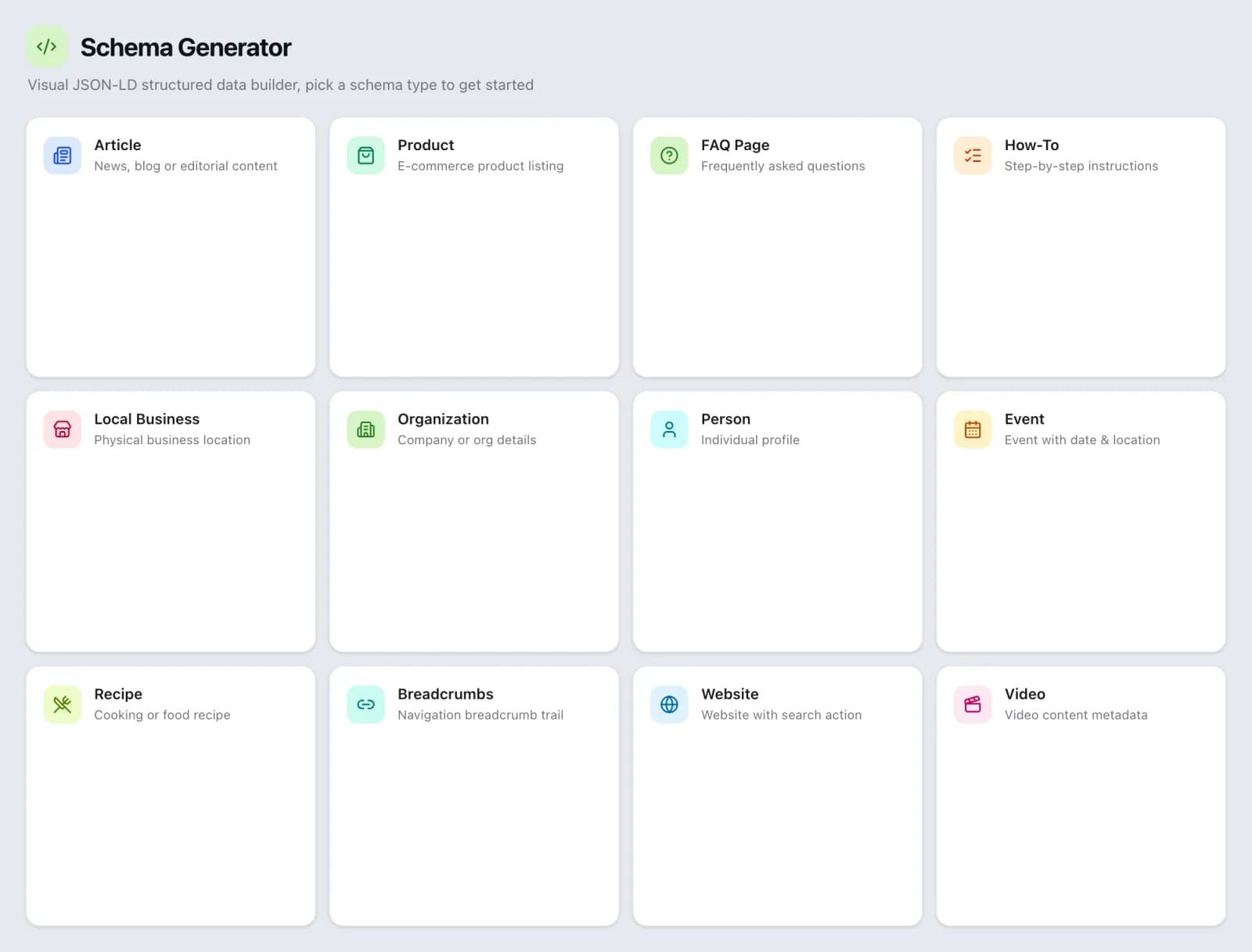
The Schema Generator is a visual builder for JSON-LD structured data. You pick a type, fill in fields, and it produces valid markup you can paste into your page, without hand-writing JSON or memorizing the vocabulary. It is free on every plan.
How to use Schema Generator
From signup to shipped fix, this is the whole loop.
- 1Create a free accountSign up in under a minute. No credit card is required, and your first site scan works without an account at all.
- 2Point Schema Generator at your siteEnter the URL or domain you want to analyze. You can run it on your own site or on a competitor's.
- 3Let it pull the live dataSchema Generator fetches the current state of the page or domain and runs its checks. Most runs finish in seconds.
- 4Read the ranked findingsResults come back ordered by impact rather than by count, so the issue costing you the most traffic is at the top, not buried under cosmetic warnings.
- 5Ship the fix, then re-runApply the recommended change, or let Roger AI draft it for you, then run the tool again to confirm the issue is resolved and track the improvement.
Why Schema Generator matters
Structured data is how you state facts about a page in a form a machine cannot misread. Left to inference, an engine has to guess whether a number on the page is a price, a rating or a part code. Marked up properly, there is nothing to guess. That certainty is what makes rich results possible and what makes your content easier for AI systems to use accurately.
Search is no longer only Google. ChatGPT, Google AI Overviews, Perplexity, Gemini and Claude answer a growing share of queries by reading the same pages crawlers do, then citing a handful of sources. SEO Roger keeps both audiences in view: the classic SERP and the AI answer, from one workspace.
Who it's for
- In-house SEOs who need crawling, indexing and structured data without stitching three tools together
- Agencies and consultants producing client-ready findings, fast
- Founders and marketers who want the fix, not just the metric
Schema Generator in depth
Why JSON-LD rather than the alternatives
Structured data can be expressed as JSON-LD, Microdata or RDFa. JSON-LD is the format Google recommends and the only one worth using for new work, because it sits in a single script block separate from your visible markup. That separation means you can add, change or remove it without touching the HTML that renders, which makes it far safer to maintain and far less likely to break during a redesign.
Eligibility is not entitlement
Valid schema makes a page eligible for rich results. It does not oblige Google to show them, and it never has. Google decides per query based on its own assessment of whether an enhanced result serves the searcher. Correct markup meaningfully improves your chances and costs little; expecting a guaranteed visual upgrade is the mistake that leads teams to conclude schema does not work.
The markup must describe what is actually visible
This is the rule that gets sites penalized. Structured data must reflect content genuinely present on the page. Marking up a rating the page does not display, an FAQ that appears nowhere, or a price different from the one shown is a guidelines violation and can trigger a manual action removing your rich results entirely. Schema describes the page; it does not decorate it with claims.
Which types are worth your time
Start where the return is highest for your content. Organization and WebSite belong on essentially every site as identity signals. Article suits editorial content. Product with genuine offer data suits ecommerce. FAQPage suits pages that genuinely answer discrete questions. HowTo suits real step-by-step processes. Breadcrumb helps almost everyone. Beyond those, the long tail of types rarely repays the effort unless you have a specific reason.
Schema Generator questions, answered
Does the generator cost credits?
No. It is free on every plan and runs in your browser.
Will adding schema improve my rankings?
Not directly. Structured data is not a ranking factor in itself. What it does is make you eligible for enhanced results that can substantially improve click-through at the same ranking position, and it helps engines and AI systems understand your content accurately. The benefit is real but arrives through visibility and comprehension rather than position.
Where do I put the generated code?
In a script tag with type application/ld+json, usually in the head, though the body is also valid. If you use a CMS, most have a field or plugin for injecting header code. The important part is that it appears in the rendered HTML that crawlers receive.
Can I mark up my own testimonials with star ratings?
No. Google prohibits review rich results built from self-serving reviews you collected and published about yourself, and doing it risks a manual action. Display testimonials as normal page content by all means. Marking them up as AggregateRating to earn stars is against the guidelines.
How do I check my markup is valid?
Validate it after publishing with Google's Rich Results Test and the Schema.org validator, which check different things: eligibility for specific Google features versus general vocabulary correctness. Generating valid markup is only half the job, since a CMS can alter or strip it during rendering.
Can one page have several schema types?
Yes, and most good implementations do. A single article page might carry Article, Breadcrumb, Organization and FAQPage simultaneously. They describe different aspects of the same page and coexist without conflict, provided each accurately describes something genuinely there.
Ready to try Schema Generator?
Create a free account and run it in minutes, plus 55+ other SEO and AI-visibility tools in the same workspace.