IndexAPI Connector
Push changed URLs to Bing, Yandex and more.
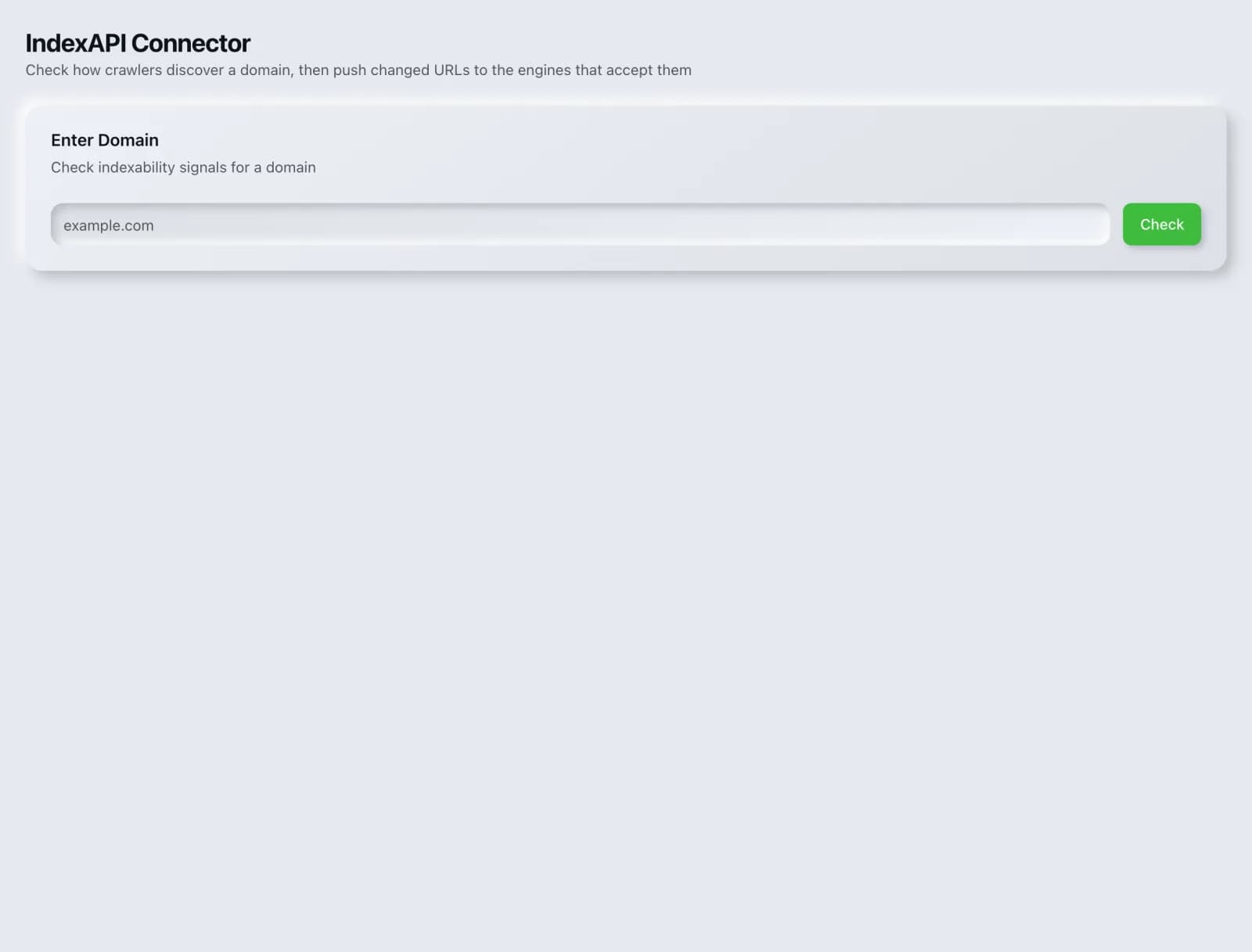
Check how discoverable your site is: read its robots.txt, auto-detect every sitemap it declares, and see what a crawler would find before you chase indexing problems.
What you get
Everything IndexAPI Connector delivers, out of the box.
Bulk URL submission
IndexNow support
Submission history
Free to use
How it works
From input to insight in three steps.
Enter your URL or keyword
Point IndexAPI Connector at any page, domain or search term, yours or a competitor's.
SEO Roger analyzes it
We run the analysis with our crawler and validators in seconds.
Get a prioritized report
Read a clear, ranked breakdown of exactly what to do next.
Related tools
More from Technical SEO.
What is IndexAPI Connector?
The IndexAPI Connector does two jobs: it checks how search engines discover your site, reading robots.txt and auto-detecting the sitemaps you declare, and it submits changed URLs over IndexNow so participating engines learn about them in minutes rather than waiting for a recrawl. IndexNow reaches Bing, Yandex, Seznam and Naver. Google does not participate. It is free on every plan.
How to use IndexAPI Connector
From signup to shipped fix, this is the whole loop.
- 1Create a free accountSign up in under a minute. No credit card is required, and your first site scan works without an account at all.
- 2Point IndexAPI Connector at your siteEnter the URL or domain you want to analyze. You can run it on your own site or on a competitor's.
- 3Let it pull the live dataIndexAPI Connector fetches the current state of the page or domain and runs its checks. Most runs finish in seconds.
- 4Read the ranked findingsResults come back ordered by impact rather than by count, so the issue costing you the most traffic is at the top, not buried under cosmetic warnings.
- 5Ship the fix, then re-runApply the recommended change, or let Roger AI draft it for you, then run the tool again to confirm the issue is resolved and track the improvement.
Why IndexAPI Connector matters
When a page will not index, the instinct is to blame content or authority. Very often the cause is duller and closer to home: the sitemap is not declared where crawlers look, the URL is not in it, or robots.txt blocks the path. Those are checkable in seconds, and checking them first saves you from optimizing a page that search engines were never able to reach.
Search is no longer only Google. ChatGPT, Google AI Overviews, Perplexity, Gemini and Claude answer a growing share of queries by reading the same pages crawlers do, then citing a handful of sources. SEO Roger keeps both audiences in view: the classic SERP and the AI answer, from one workspace.
Who it's for
- In-house SEOs who need crawling, indexing and structured data without stitching three tools together
- Agencies and consultants producing client-ready findings, fast
- Founders and marketers who want the fix, not just the metric
IndexAPI Connector in depth
The discovery chain, in order
A search engine finds a page one of three ways: a link from a page it already knows, an entry in a sitemap, or a direct submission. The first two are what this tool inspects. It reads robots.txt to see what is permitted and whether a Sitemap directive is present, then follows that directive and the conventional locations to find the sitemaps your site actually declares.
Declaring the sitemap is the step people miss
A sitemap that exists at a path nobody advertises still gets found eventually, but a single Sitemap line in robots.txt gives every crawler a direct route without depending on convention or on you submitting it in each engine's console. It is one line, and it is the most commonly missing one.
Read robots.txt as a crawler does
The most consequential thing this surfaces is a disallow rule that is broader than intended. Remember that disallow is not noindex: a blocked URL can still appear in results as a bare link if other sites point at it, while the engine is forbidden from reading the noindex you added. If a page must stay out of the index, it has to be crawlable enough for the engine to see that instruction.
Submitting, and the key file that makes it possible
IndexNow proves you own a host by having you publish a key file on it. Generate a key here, put the file at your site root, and the tool verifies it before letting you submit, because an unverified key means every URL is rejected. That same mechanism is why this works on any domain with no connection step: the engines check ownership, not us. Google is a deliberate gap rather than an oversight: it does not participate in IndexNow, and its own Indexing API is documented for JobPosting and BroadcastEvent only, so a declared sitemap plus Search Console remain the routes into Google.
IndexAPI Connector questions, answered
Does it cost credits?
No. It is free on every plan. It fetches your robots.txt and sitemaps on our own infrastructure with no paid data provider involved.
Does this submit my URLs to Google?
Not to Google, no, and no tool can: Google does not participate in IndexNow, and its own Indexing API is documented for job postings and broadcast events rather than ordinary pages. Submission here reaches Bing, Yandex, Seznam and Naver. For Google, keep a healthy sitemap declared in robots.txt and use Search Console, which is exactly what the discovery check helps you confirm.
Why is my page not indexed even though the sitemap is fine?
A clean discovery path only guarantees the engine can reach the page, not that it will choose to index it. Once discovery checks out, the usual causes are a noindex directive, a canonical pointing elsewhere, thin or duplicate content, or simply a new page on a site that is crawled infrequently. Check the first two with Meta Tag Placement.
Where should my sitemap live?
Anywhere reachable, but declare it with a Sitemap line in robots.txt so crawlers do not have to guess. The conventional path is /sitemap.xml, and following that convention costs nothing and helps the tools that assume it.
Do I need a sitemap at all if my internal linking is good?
Strong internal linking does most of the work, and a small well-linked site will be found without one. A sitemap still earns its place on larger sites, on anything with pages that are not linked from many places, and as a way to communicate that a page changed. It is cheap insurance rather than a substitute for good linking.
It found no sitemap. Is that a problem?
It is worth fixing. Either you do not have one, in which case generate one, or you have one that is not declared and not at a conventional path, in which case crawlers are relying on links alone to find everything. Adding a Sitemap line to robots.txt resolves the second case immediately.
Ready to try IndexAPI Connector?
Create a free account and run it in minutes, plus 55+ other SEO and AI-visibility tools in the same workspace.