
Keyword Density
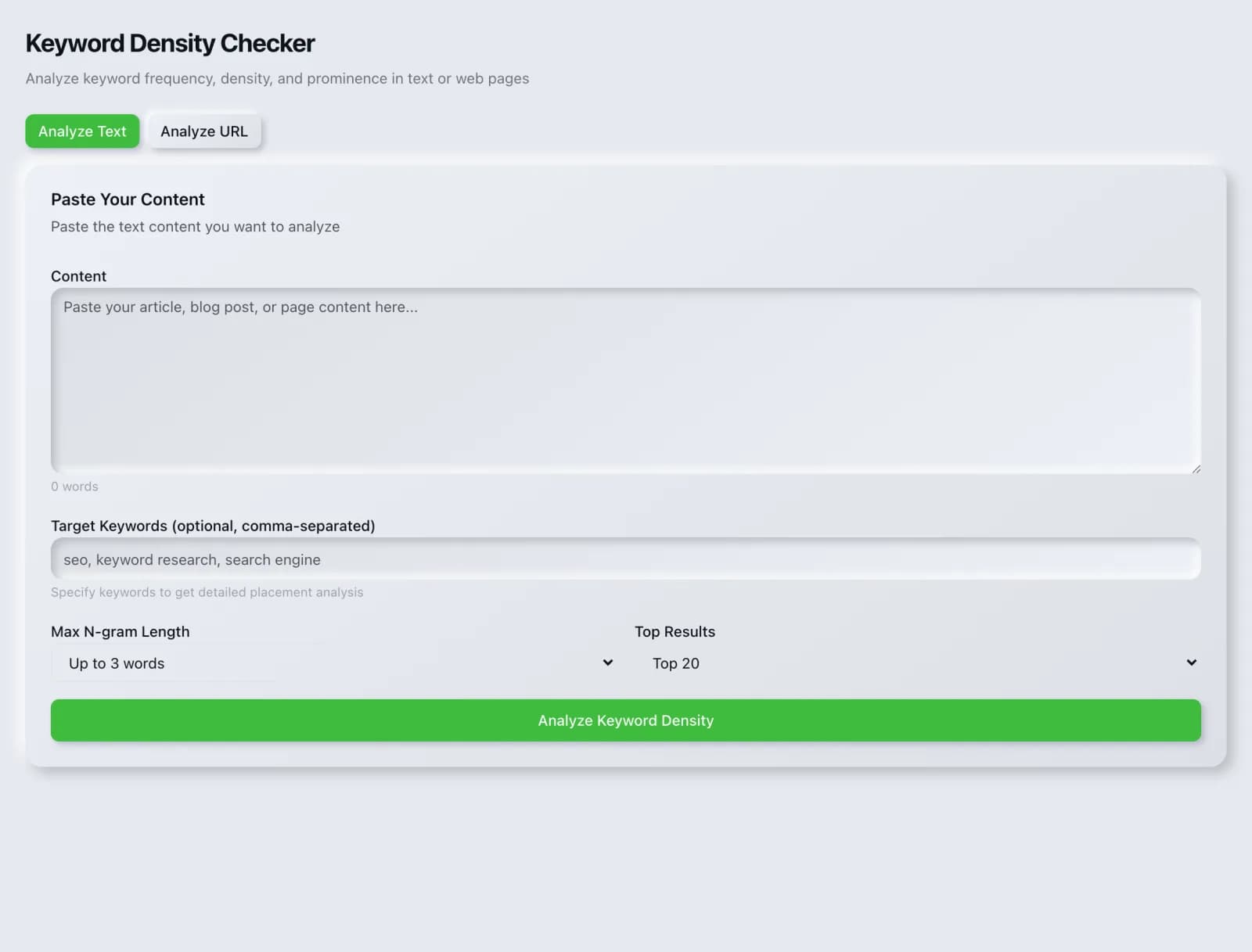
Analyze keyword and n-gram frequency.
Measure keyword and phrase density to avoid stuffing and confirm topical coverage.
What you get
Everything Keyword Density delivers, out of the box.
1–3 word n-grams
Density percentages
Stuffing warnings
Free to use
How it works
From input to insight in three steps.
Enter your URL or keyword
Point Keyword Density at any page, domain or search term, yours or a competitor's.
SEO Roger analyzes it
We run the analysis with our on-page analyzer in seconds.
Get a prioritized report
Read a clear, ranked breakdown of exactly what to do next.
Related tools
More from Content & On-Page.
What is Keyword Density?
Keyword Density measures how often a term or phrase appears in a piece of content relative to its total length, and reports n-gram frequency so you can see which phrases actually dominate the text. It is free on every plan.
How to use Keyword Density
From signup to shipped fix, this is the whole loop.
- 1Create a free accountSign up in under a minute. No credit card is required, and your first site scan works without an account at all.
- 2Point Keyword Density at your siteEnter the URL or domain you want to analyze. You can run it on your own site or on a competitor's.
- 3Let it pull the live dataKeyword Density fetches the current state of the page or domain and runs its checks. Most runs finish in seconds.
- 4Read the ranked findingsResults come back ordered by impact rather than by count, so the issue costing you the most traffic is at the top, not buried under cosmetic warnings.
- 5Ship the fix, then re-runApply the recommended change, or let Roger AI draft it for you, then run the tool again to confirm the issue is resolved and track the improvement.
Why Keyword Density matters
This tool is worth using for one purpose and worth ignoring for another. It is genuinely useful for catching over-optimization, where a term has been repeated so insistently that the writing reads badly and looks manipulative. It is not useful as a target to hit, because there is no density figure that improves rankings, and treating one as a goal is how content ends up worse than it started.
Search is no longer only Google. ChatGPT, Google AI Overviews, Perplexity, Gemini and Claude answer a growing share of queries by reading the same pages crawlers do, then citing a handful of sources. SEO Roger keeps both audiences in view: the classic SERP and the AI answer, from one workspace.
Who it's for
- In-house SEOs who need on-page content and metadata without stitching three tools together
- Agencies and consultants producing client-ready findings, fast
- Founders and marketers who want the fix, not just the metric
Keyword Density in depth
There is no optimal keyword density
Worth stating plainly, because a great deal of older advice says otherwise. Search engines moved past simple term-frequency matching many years ago, toward understanding meaning, context and related concepts. No percentage unlocks anything. Any guide recommending a specific figure, whether one percent or three, is repeating an idea that stopped being true a long time ago.
What the number is actually good for
Use it as a smell test in one direction only. If your target phrase turns out to be four percent of the text, the page almost certainly reads as repetitive and forced, and that is a real problem for readers and a pattern search engines discount. The tool is a way to notice that, not a dial to tune.
N-grams reveal what the page is really about
The more interesting output is the phrase frequency list, because it shows the vocabulary the page actually emphasizes, which is often not what the author intended. A page meant to be about one subject that turns out to be dominated by a supporting topic has a focus problem worth knowing about, and that is invisible when reading your own draft.
Write for coverage, not frequency
The modern equivalent of the old density question is whether you have covered the concepts a knowledgeable piece on this subject would naturally cover. That means related terms, subtopics and the questions readers have, appearing because the writing addresses them rather than because they were inserted. Coverage is what the current generation of ranking systems assesses; repetition is what the previous one measured.
Keyword Density questions, answered
Does it cost credits?
No. Keyword Density is free on every plan.
What keyword density should I aim for?
None. There is no target that helps, and pursuing one produces worse content. Write naturally, then use this to check you have not accidentally over-repeated something. That is the whole of the useful application.
Is keyword density a ranking factor?
No. Search engines have used semantic understanding rather than raw term frequency for many years. Density is a diagnostic for over-optimization, not an input to ranking.
Can high density trigger a penalty?
Extreme keyword stuffing is against Google's spam policies and can be actioned. Ordinary repetition from enthusiastic writing will not be penalized; it will simply read badly and perform worse with human readers, which is reason enough to fix it.
Should my exact keyword appear at all?
Using the phrase naturally where it fits, including somewhere near the start, helps confirm what the page is about. Beyond that, variations and related terms serve you better than repeating one exact string.
What about LSI keywords?
LSI is a specific older information-retrieval technique that is not what modern search engines use, despite the term's persistence in SEO writing. The underlying instinct, that covering related concepts helps, is sound. The label is inaccurate, and no tool can give you a real list of LSI keywords.
Ready to try Keyword Density?
Create a free account and run it in minutes, plus 55+ other SEO and AI-visibility tools in the same workspace.