
Keyword Research
Find the terms worth targeting.
Discover keyword ideas, search volume, difficulty and intent so you build content around demand: keyword ideas are free; live volume uses a credit.
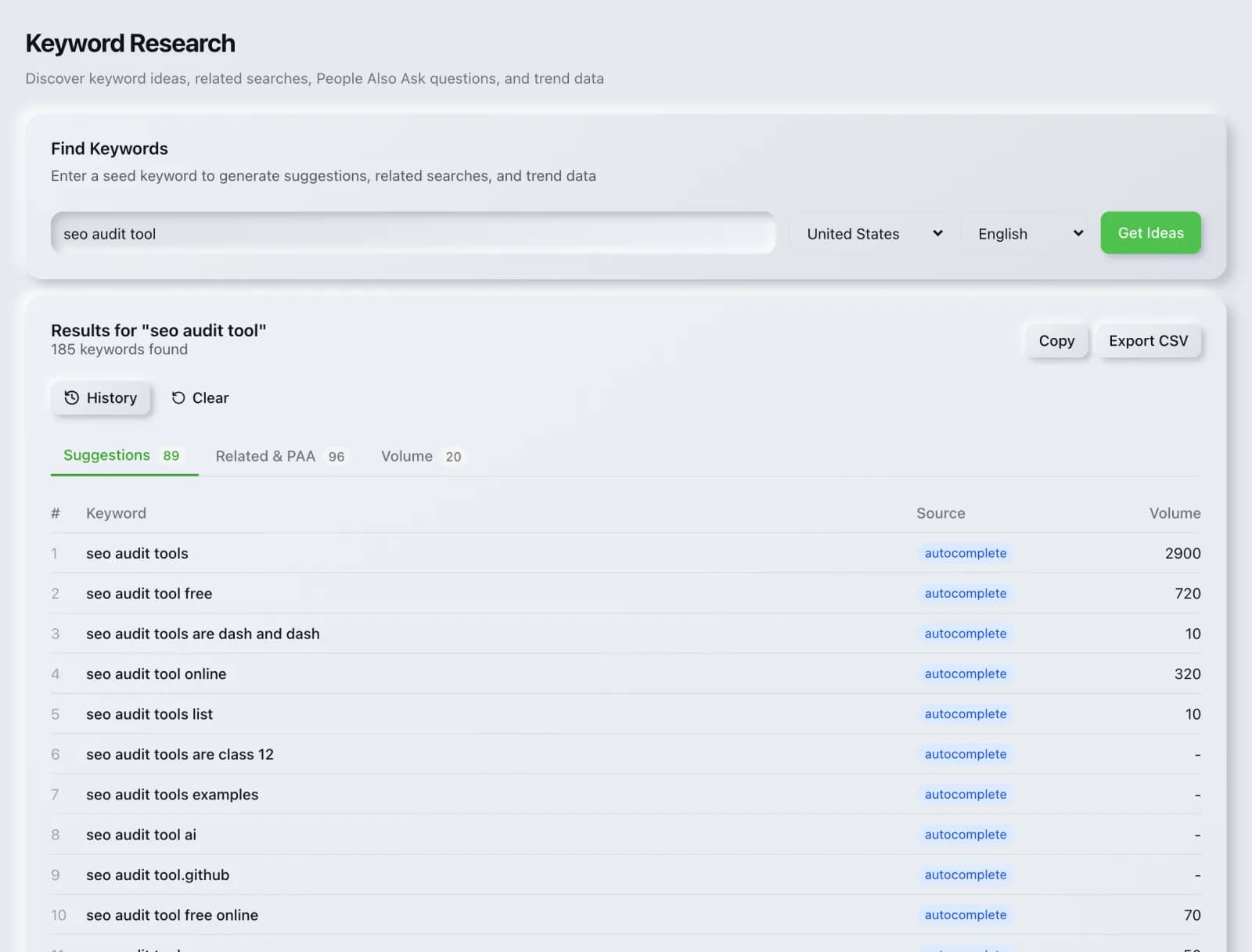
What you get
Everything Keyword Research delivers, out of the box.
Keyword ideas (free)
Search volume & difficulty
Intent classification
Group into content clusters
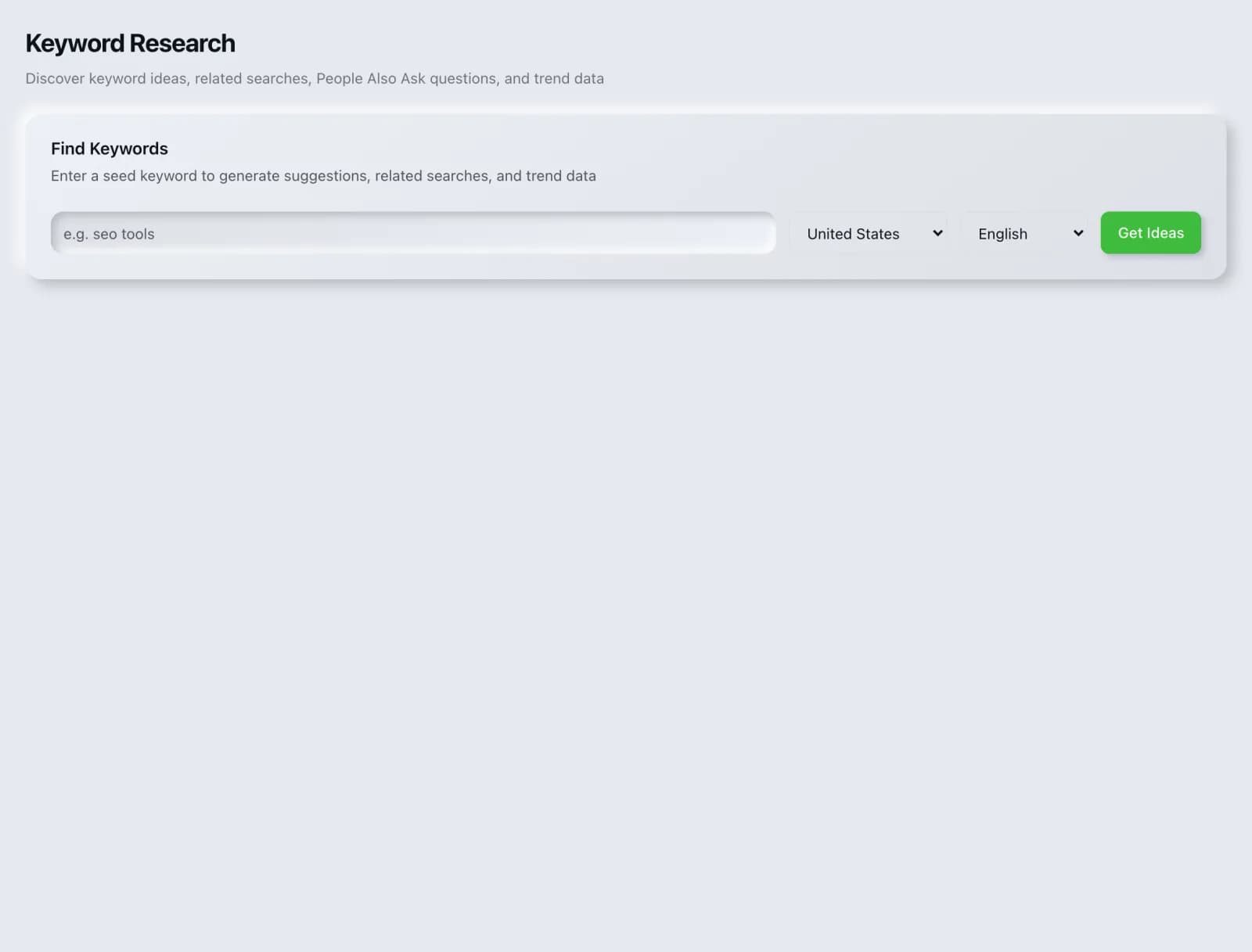
Where you start
Keyword Research before you run it: the inputs it asks for, and nothing else to wade through.
How it works
From input to insight in three steps.
Enter your URL or keyword
Point Keyword Research at any page, domain or search term, yours or a competitor's.
SEO Roger analyzes it
We run the analysis with DataForSEO's live SERP data in seconds.
Get a prioritized report
Read a clear, ranked breakdown of exactly what to do next.
Related tools
More from Rankings & Keywords.
What is Keyword Research?
Keyword Research finds the terms people actually search for in your category and tells you what each one is worth. For every keyword you get monthly search volume, cost per click, competition level and a difficulty score derived from ad competition, so you can separate terms worth pursuing from terms that only look attractive. Volume lookups cost 4 credits per batch.
How to use Keyword Research
From signup to shipped fix, this is the whole loop.
- 1Create a free accountSign up in under a minute. No credit card is required, and your first site scan works without an account at all.
- 2Point Keyword Research at your siteEnter the URL or domain you want to analyze. You can run it on your own site or on a competitor's.
- 3Let it pull the live dataKeyword Research fetches the current state of the page or domain and runs its checks. Most runs finish in seconds.
- 4Read the ranked findingsResults come back ordered by impact rather than by count, so the issue costing you the most traffic is at the top, not buried under cosmetic warnings.
- 5Ship the fix, then re-runApply the recommended change, or let Roger AI draft it for you, then run the tool again to confirm the issue is resolved and track the improvement.
Why Keyword Research matters
Most content that fails does so before a word is written, because it targets a phrase nobody searches or one that established sites already own. Research is how you find the middle: real demand, achievable difficulty and intent that matches what you sell. It is the cheapest step in the process and the one that determines whether the rest was worth doing.
Search is no longer only Google. ChatGPT, Google AI Overviews, Perplexity, Gemini and Claude answer a growing share of queries by reading the same pages crawlers do, then citing a handful of sources. SEO Roger keeps both audiences in view: the classic SERP and the AI answer, from one workspace.
Who it's for
- In-house SEOs who need keyword rankings and search demand without stitching three tools together
- Agencies and consultants producing client-ready findings, fast
- Founders and marketers who want the fix, not just the metric
Keyword Research in depth
Volume is a starting point, not the decision
A term with 500 monthly searches and clear buying intent will usually beat one with 50,000 searches and none. Read volume next to cost per click, which is the closest public proxy for commercial value: advertisers do not bid on terms that do not convert. High volume with near-zero CPC is often informational or navigational traffic that will never buy.
How difficulty is calculated here
The difficulty score is derived from ad competition data and bucketed into easy, medium and hard. It is directional, not absolute, and no vendor has access to Google's actual ranking calculus. Use it to sort a list quickly, then sanity-check the shortlist by looking at who currently ranks and whether you can credibly produce something better.
Intent decides the format of the page
The same topic supports very different pages depending on how it is phrased. Informational queries want a guide, comparison queries want a comparison, and transactional queries want a product or category page. Matching the format to intent matters more than keyword density ever did, and mismatching it is why well-written pages sometimes never rank.
Finding gaps instead of guessing
The fastest source of viable keywords is usually your competitors. Keyword Gap lists terms rivals rank for and you do not, filtered by volume and difficulty, so you start from demand proven in your market rather than from a blank page.
Keyword Research questions, answered
What is keyword research?
It is the process of finding the search terms your audience uses, then judging each one on demand, difficulty and intent so you can decide what to create. SEO Roger returns volume, CPC, competition and a difficulty score for each term.
How much does keyword research cost in SEO Roger?
Keyword ideas and autocomplete suggestions are free on every plan and never spend credits. Search volume lookups, which call a paid data provider, cost 4 credits per batch.
What is a good search volume to target?
There is no universal number, because value depends on intent and your margins. For most businesses a cluster of specific terms in the hundreds of searches per month converts better than one broad term in the tens of thousands. Look at CPC alongside volume: advertisers paying real money for a term is decent evidence it converts.
How is keyword difficulty calculated?
SEO Roger derives it from ad competition data and buckets it into easy, medium and hard. It is a directional signal rather than a precise prediction, since no third party can see Google's ranking model. Use it to triage a long list, then verify the shortlist by examining who ranks now.
What is search intent and why does it matter?
Intent is what the searcher actually wants: to learn, to compare, or to buy. It dictates the page format that can rank, because Google shows what has historically satisfied that query. Publishing a sales page for an informational query, or a blog post for a transactional one, is one of the most common reasons a good page never ranks.
How do I find keywords my competitors rank for?
Run Keyword Gap against their domain and yours. It returns the terms they rank for that you do not, with volume and difficulty attached, which turns competitor research into a prioritized shortlist rather than a giant export you have to manually filter.
Ready to try Keyword Research?
Create a free account and run it in minutes, plus 55+ other SEO and AI-visibility tools in the same workspace.