Position Tracking
See your ranking trends, visibility and movers.
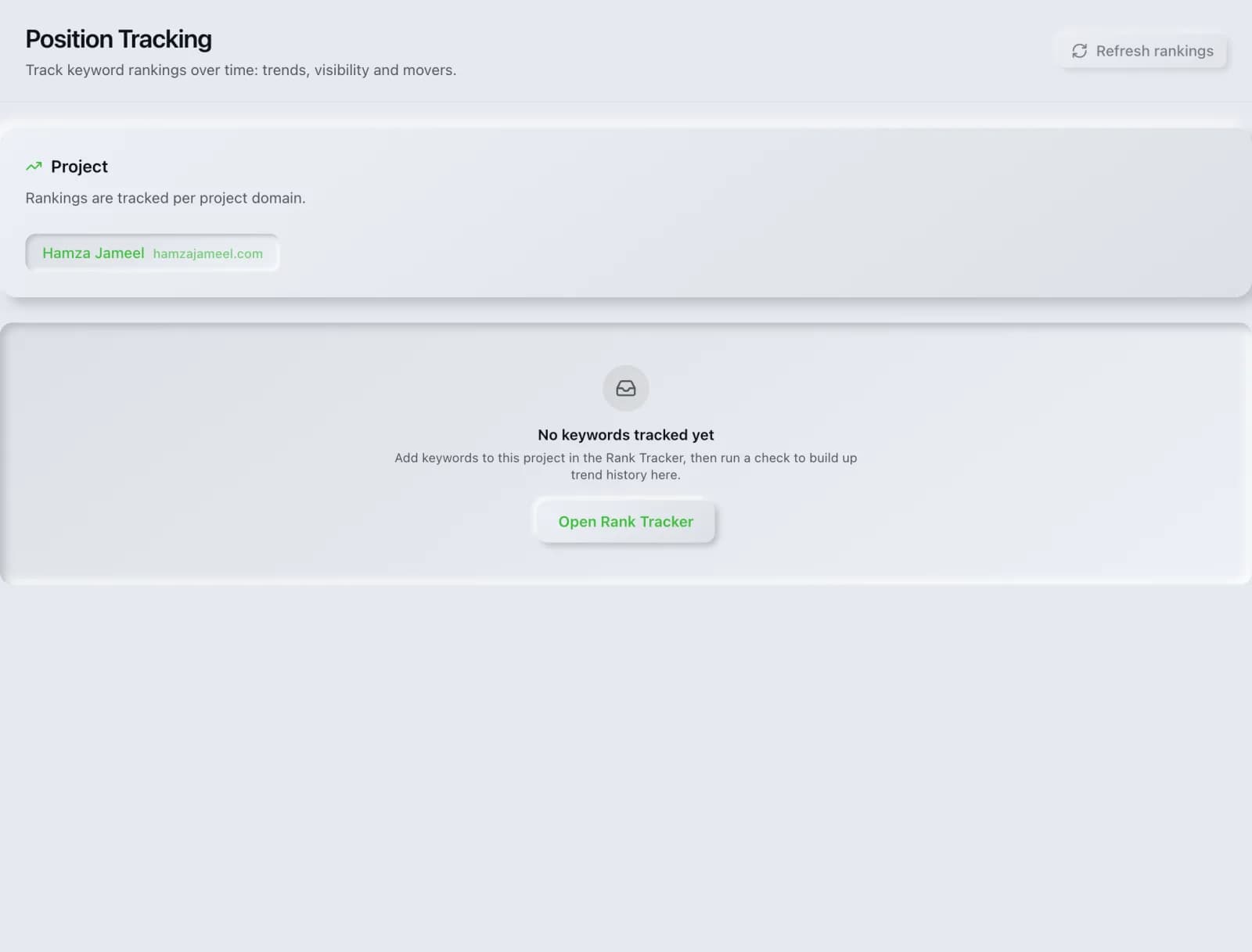
A trends dashboard on top of your tracked keywords: average position over time, a visibility score, and your biggest movers up and down.
What you get
Everything Position Tracking delivers, out of the box.
Position trend charts
Visibility score
Biggest movers up & down
Top-10 tracking
How it works
From input to insight in three steps.
Enter your URL or keyword
Point Position Tracking at any page, domain or search term, yours or a competitor's.
SEO Roger analyzes it
We run the analysis with DataForSEO's live SERP data in seconds.
Get a prioritized report
Read a clear, ranked breakdown of exactly what to do next.
Related tools
More from Rankings & Keywords.
What is Position Tracking?
Position Tracking is the trends layer on top of your tracked keywords: average position over time, a visibility score that weights each ranking by how much traffic that position typically earns, and your biggest movers up and down since the last check. It costs 1 credit per check, covering up to 10 keywords.
How to use Position Tracking
From signup to shipped fix, this is the whole loop.
- 1Create a free accountSign up in under a minute. No credit card is required, and your first site scan works without an account at all.
- 2Point Position Tracking at your siteEnter the URL or domain you want to analyze. You can run it on your own site or on a competitor's.
- 3Let it pull the live dataPosition Tracking fetches the current state of the page or domain and runs its checks. Most runs finish in seconds.
- 4Read the ranked findingsResults come back ordered by impact rather than by count, so the issue costing you the most traffic is at the top, not buried under cosmetic warnings.
- 5Ship the fix, then re-runApply the recommended change, or let Roger AI draft it for you, then run the tool again to confirm the issue is resolved and track the improvement.
Why Position Tracking matters
A list of current positions answers where you are but not whether you are winning. Individual keywords bounce around constantly for reasons that have nothing to do with you, so reacting to any single movement is mostly reacting to noise. Trend and visibility aggregate across your whole keyword set, which is the level at which real change becomes distinguishable from daily fluctuation.
Search is no longer only Google. ChatGPT, Google AI Overviews, Perplexity, Gemini and Claude answer a growing share of queries by reading the same pages crawlers do, then citing a handful of sources. SEO Roger keeps both audiences in view: the classic SERP and the AI answer, from one workspace.
Who it's for
- In-house SEOs who need keyword rankings and search demand without stitching three tools together
- Agencies and consultants producing client-ready findings, fast
- Founders and marketers who want the fix, not just the metric
Position Tracking in depth
Why visibility beats average position
Average position treats a move from 18 to 12 as identical to a move from 7 to 1, when the traffic consequences are wildly different. Click-through rate collapses steeply with rank, so almost all the value sits in the top few positions. A visibility score weights each ranking by the traffic that position typically earns, which means it rises when you gain ground where it counts and stays flat when you improve deep positions nobody clicks.
Movers are the actionable part
The trend line tells you the direction, but the movers list tells you what to do this week. A cluster of related terms dropping together usually means something structural: a page lost its rankings, a template changed, or a competitor published something comprehensive. A cluster rising together usually means a page you improved is being re-evaluated. Isolated single-keyword moves are usually noise and are the most common thing people over-react to.
Reading a drop before panicking
Ranking drops have a small number of common causes, and it is worth working through them in order. Check whether the page still returns 200 and is still indexable, because accidental noindex tags and broken redirects are the most common self-inflicted cause. Check whether the results themselves changed shape, since a new AI overview or featured snippet block can push everything down without you losing anything. Then check whether a competitor published something better. Only then consider an algorithm update.
How often to check
Weekly suits most sites and keeps your credit spend proportionate. Daily checking rarely changes a decision, because you cannot ship a meaningful fix daily, and it multiplies cost while adding mostly noise. Check daily only around a launch, a migration or a confirmed algorithm update, when you genuinely need to see movement quickly.
Position Tracking questions, answered
How much does tracking cost in credits?
1 credit per 10 keywords per check, rounded up with a minimum of 1. Checking 25 keywords costs 3 credits each time. Because you are charged per check rather than per month, your spend follows how often you actually look rather than how many keywords you have registered.
How is this different from Rank Tracker?
Rank Tracker records the positions. Position Tracking is the analysis layer over that history: trends, visibility and movers. You need tracked keywords with some history before this becomes useful, so start there and come here once the data has accumulated.
Why do my positions differ from what I see in Google?
Because what you see is personalized. Your results are shaped by your location, your search history, whether you are signed in, and your device. Tracked positions are measured from a consistent, non-personalized location so they can be compared over time. The tracked number is the more reliable measure of change even when it does not match your own screen.
How long before a change shows up?
Usually days to weeks, occasionally longer. Google has to recrawl the page, reassess it and let the change settle, and for competitive terms the reassessment is gradual rather than instant. Expect to wait at least two weeks after a substantive change before concluding it did not work.
What counts as a meaningful drop?
A sustained drop across a group of related keywords over multiple checks. A single keyword moving a few positions between checks is normal fluctuation and needs no response. The pattern that warrants investigation is several related terms moving together in the same direction and staying there.
Does a rising visibility score guarantee more traffic?
No. Visibility models the traffic your positions typically earn, but actual clicks depend on how many people search that month, how many AI overviews and other blocks sit above the organic results, and how compelling your titles are. Visibility rising while clicks stay flat usually means the results page changed shape around you.
Ready to try Position Tracking?
Create a free account and run it in minutes, plus 55+ other SEO and AI-visibility tools in the same workspace.