
On-Page Analysis
Every on-page & internal-link issue in one crawl.
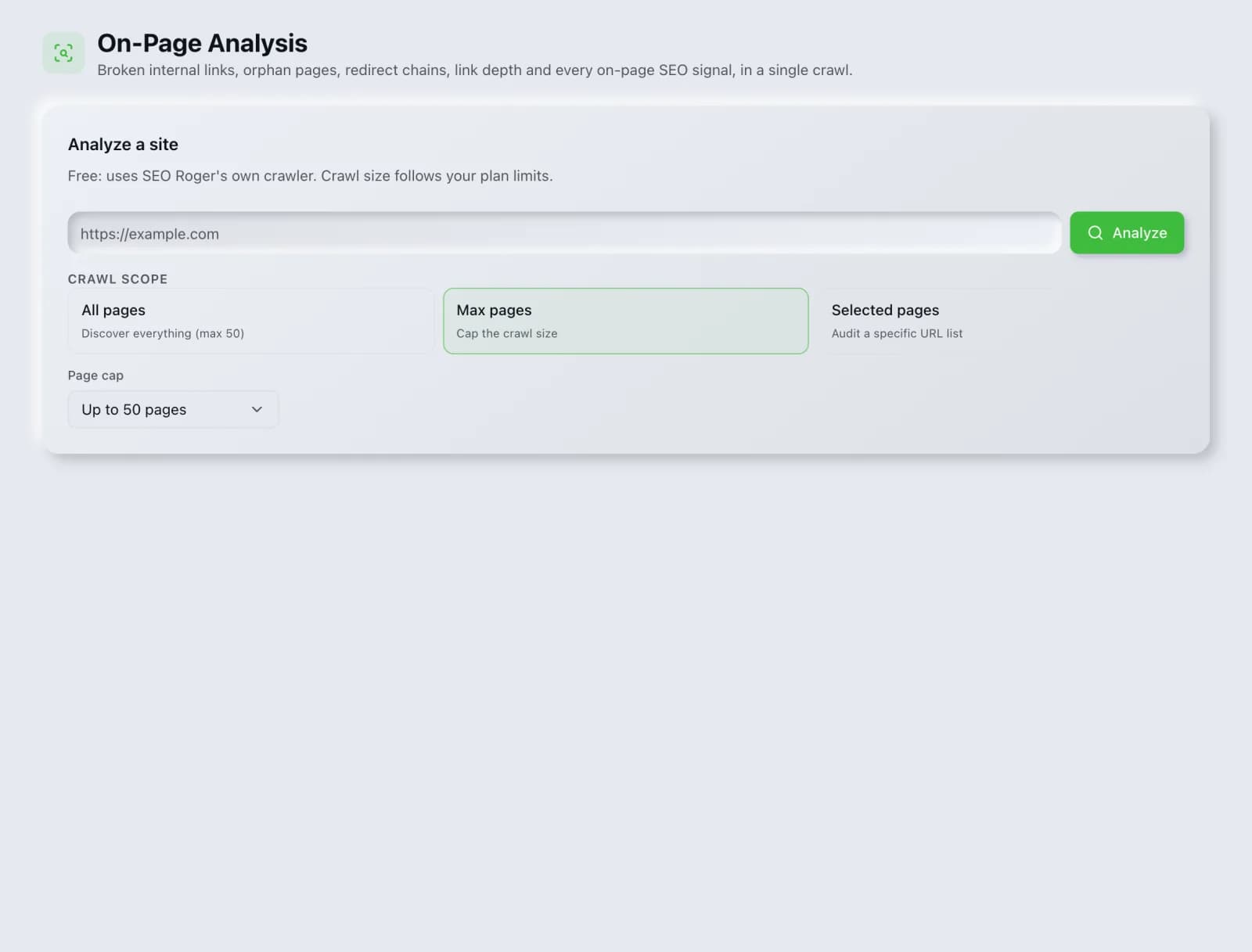
A single crawl that maps broken internal links (with anchor text), orphan pages, redirect chains, per-page inbound-link depth and every on-page SEO signal: titles, meta, H1s, alt text, canonicals, thin content and schema.
What you get
Everything On-Page Analysis delivers, out of the box.
Broken links + anchor text
Orphan-page detection
Redirect-chain finder
Per-page link depth
On-page SEO breakdown
CSV export
How it works
From input to insight in three steps.
Enter your URL or keyword
Point On-Page Analysis at any page, domain or search term, yours or a competitor's.
SEO Roger analyzes it
We run the analysis with our crawler and validators in seconds.
Get a prioritized report
Read a clear, ranked breakdown of exactly what to do next.
Related tools
More from Technical SEO.
What is On-Page Analysis?
On-Page Analysis is a single crawl that maps your internal link structure and every on-page signal at once: broken internal links with their anchor text, orphan pages, redirect chains, how deep each page sits from the homepage, and per-page titles, meta descriptions, H1s, alt text, canonicals, thin content and schema. It is free on every plan.
How to use On-Page Analysis
From signup to shipped fix, this is the whole loop.
- 1Create a free accountSign up in under a minute. No credit card is required, and your first site scan works without an account at all.
- 2Point On-Page Analysis at your siteEnter the URL or domain you want to analyze. You can run it on your own site or on a competitor's.
- 3Let it pull the live dataOn-Page Analysis fetches the current state of the page or domain and runs its checks. Most runs finish in seconds.
- 4Read the ranked findingsResults come back ordered by impact rather than by count, so the issue costing you the most traffic is at the top, not buried under cosmetic warnings.
- 5Ship the fix, then re-runApply the recommended change, or let Roger AI draft it for you, then run the tool again to confirm the issue is resolved and track the improvement.
Why On-Page Analysis matters
Internal linking is the most underused lever in SEO. It is entirely within your control, requires no outreach and no permission, and it determines both how search engines discover your pages and how authority flows between them. Most sites have never looked at it as a structure, which is why orphan pages and twelve-click-deep content are so common.
Search is no longer only Google. ChatGPT, Google AI Overviews, Perplexity, Gemini and Claude answer a growing share of queries by reading the same pages crawlers do, then citing a handful of sources. SEO Roger keeps both audiences in view: the classic SERP and the AI answer, from one workspace.
Who it's for
- In-house SEOs who need crawling, indexing and structured data without stitching three tools together
- Agencies and consultants producing client-ready findings, fast
- Founders and marketers who want the fix, not just the metric
On-Page Analysis in depth
Orphan pages are invisible until you crawl for them
An orphan page has no internal links pointing to it. It might be perfectly good content, published and forgotten when a category was reorganized or a navigation menu was rebuilt. Search engines struggle to find it, users cannot navigate to it, and it receives no authority from the rest of the site. Because it looks completely normal when you open it directly, the only way to find orphans is to map the link graph.
Click depth is a ranking constraint
How many clicks a page sits from the homepage correlates strongly with how often it is crawled and how much authority reaches it. Anything more than about three or four clicks deep is treated as peripheral. Large sites accumulate depth naturally through pagination and category nesting, and the fix is usually structural: better hub pages, links from high-authority pages directly to deep ones, and less reliance on pagination as the only route.
Anchor text is a signal you control completely
The words in a link tell search engines what the destination is about, and internal anchor text is the one form of anchor text you fully control. A site whose internal links all read click here or read more forfeits that entirely. Descriptive anchors that state what the destination covers help both crawlers and the substantial number of users who navigate by scanning links.
One crawl instead of five tools
The reason this tool exists is that these problems interact. A redirect chain creates a page that is deeper than it appears. A broken internal link creates an orphan. Thin content on a page that receives many internal links is a misallocation of authority. Seeing them from a single crawl lets you spot the relationships rather than treating each finding as an isolated item on five separate lists.
On-Page Analysis questions, answered
Does it cost credits?
No. On-Page Analysis is free on every plan, since it runs on our own crawler.
How many pages does it crawl?
Up to your plan's limit: 50 on Free, 500 on Starter, 2,000 on Pro and 10,000 on Agency. Runs are clamped to the ceiling rather than failing.
How is this different from the Full Site Audit?
They overlap, with different emphasis. The Full Site Audit grades eleven modules including performance, security and structured data, giving you overall site health. On-Page Analysis goes deeper specifically on internal linking and per-page on-page signals. Use the audit for a health check and this when internal structure is the problem you are working on.
How do I fix an orphan page?
Link to it from somewhere relevant and reasonably authoritative, ideally a category or hub page that already receives internal links itself. If nothing sensible would link to it, that is a strong signal the page may not be worth keeping, in which case merging or removing it is the better answer.
How many internal links should a page have?
There is no correct number. What matters is that links are relevant, descriptive and lead somewhere useful. A long reference article naturally carries many; a focused landing page carries few. Adding links to hit a count produces noise that dilutes the ones that matter.
Does the crawl affect my server?
It is rate-limited and respects robots.txt, so it behaves like a well-mannered crawler. On a very large site a deep crawl generates real traffic, so if your server is under strain it is worth scheduling during a quiet period.
Ready to try On-Page Analysis?
Create a free account and run it in minutes, plus 55+ other SEO and AI-visibility tools in the same workspace.