
Reputation SEO Analyzer
Score the trust signals that make AI recommend you.
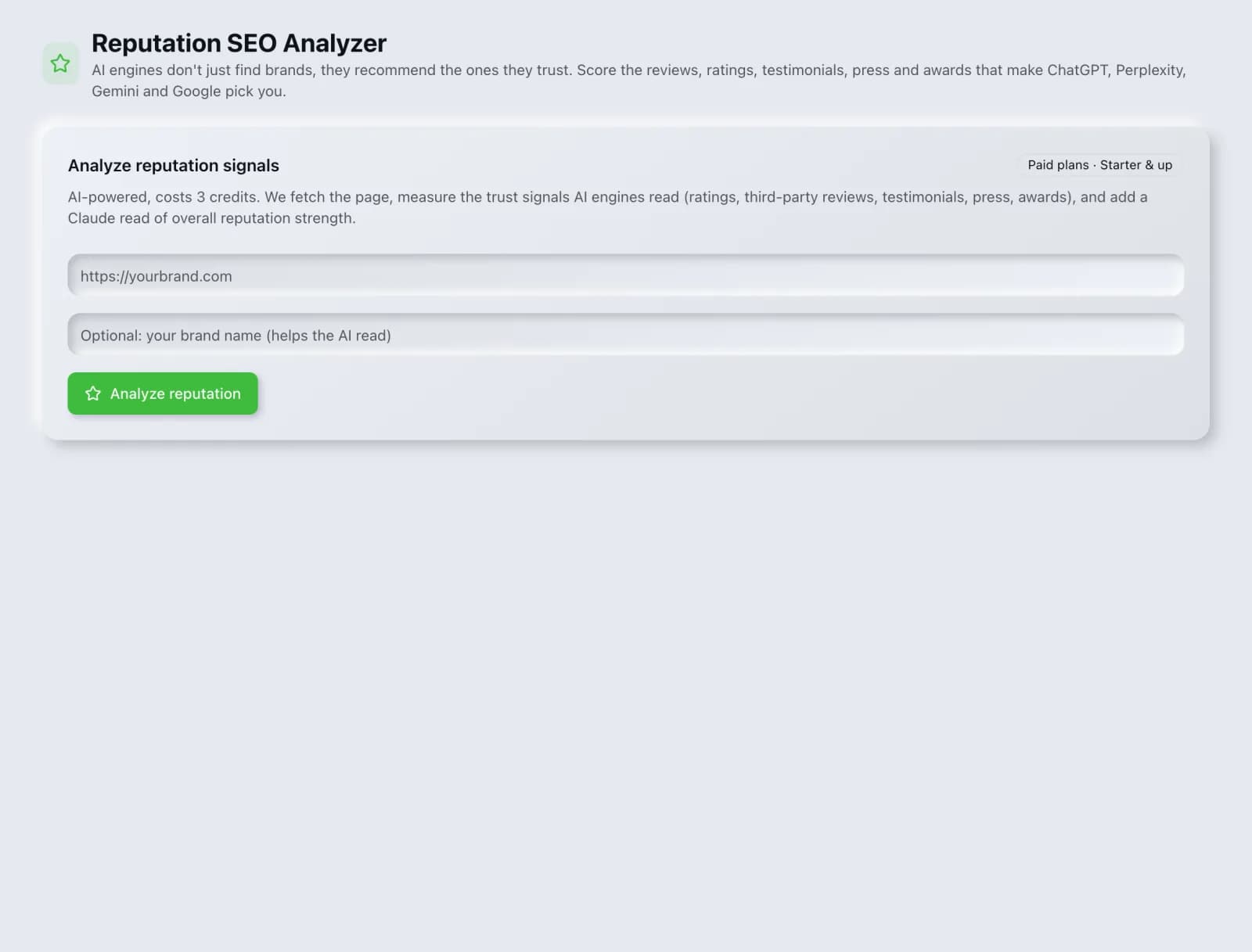
AI engines don't just find brands, they recommend the ones they trust. We fetch your page and measure the reputation signals answer engines read: review and AggregateRating schema, visible ratings, third-party review platforms (G2, Trustpilot, Google, Yelp), testimonials, press and 'as seen in' mentions, awards and certifications, case studies and author credibility, then add a Roger read of overall reputation strength and sentiment with prioritized fixes.
What you get
Everything Reputation SEO Analyzer delivers, out of the box.
Reputation Strength score + grade
Review-schema & third-party audit
Press, awards & testimonial signals
Prioritized, page-specific fixes
How it works
From input to insight in three steps.
Enter your URL or keyword
Point Reputation SEO Analyzer at any page, domain or search term, yours or a competitor's.
SEO Roger analyzes it
We run the analysis with Roger AI across the major AI engines in seconds.
Get a prioritized report
Read a clear, ranked breakdown of exactly what to do next.
Related tools
More from AI Visibility.
What is Reputation SEO Analyzer?
Reputation SEO Analyzer measures the trust signals that lead engines to recommend a brand: review and rating markup, visible ratings, presence on third-party review platforms, testimonials, press mentions, awards and certifications, case studies and author credibility. It fetches your page, scores each signal and adds an AI assessment of overall reputation strength with prioritized fixes. It costs 3 credits and is available on Starter, Pro and Agency plans.
How to use Reputation SEO Analyzer
From signup to shipped fix, this is the whole loop.
- 1Create a free accountSign up in under a minute. No credit card is required, and your first site scan works without an account at all.
- 2Point Reputation SEO Analyzer at your siteEnter the URL or domain you want to analyze. You can run it on your own site or on a competitor's.
- 3Let it pull the live dataReputation SEO Analyzer fetches the current state of the page or domain and runs its checks. Most runs finish in seconds.
- 4Read the ranked findingsResults come back ordered by impact rather than by count, so the issue costing you the most traffic is at the top, not buried under cosmetic warnings.
- 5Ship the fix, then re-runApply the recommended change, or let Roger AI draft it for you, then run the tool again to confirm the issue is resolved and track the improvement.
Why Reputation SEO Analyzer matters
Answer engines do not just locate businesses, they recommend them, and a recommendation requires some basis for trust. When someone asks an assistant for the best supplier in a category, the systems assembling that answer lean on corroborating evidence from sources other than the business itself. Being findable is table stakes; being credible is what gets you named.
Search is no longer only Google. ChatGPT, Google AI Overviews, Perplexity, Gemini and Claude answer a growing share of queries by reading the same pages crawlers do, then citing a handful of sources. SEO Roger keeps both audiences in view: the classic SERP and the AI answer, from one workspace.
Who it's for
- Brands that want to be recommended by ChatGPT, Perplexity and AI Overviews, not just ranked in Google
- In-house SEOs who need visibility inside AI answer engines without stitching three tools together
- Agencies and consultants producing client-ready findings, fast
- Founders and marketers who want the fix, not just the metric
Reputation SEO Analyzer in depth
Third-party evidence outweighs your own claims
Anything on your own site is a claim you control. A rating on an independent review platform, a mention in a publication that does not depend on you, or a certification from a recognized body is evidence you do not control, which is exactly why it carries more weight. This is why presence on external platforms is scored heavily here and why testimonials on your own page, while worth having, count for less.
The rich-results rule you must not break
Google does not permit review rich results based on reviews you collected and published about yourself. Self-serving AggregateRating markup, where a business marks up its own testimonials to try to earn stars in search results, is against the structured data guidelines and can trigger a manual action against your site. Review markup is for reviews of other things, or for reviews sourced from genuinely independent platforms. Displaying testimonials is fine. Marking your own up for stars is not.
Where reputation and expertise meet
Search quality guidelines weigh experience, expertise, authoritativeness and trust, and these are assessed at the level of content, author and site. Named authors with verifiable credentials, clear contact and ownership details, case studies with specifics rather than adjectives, and citations from credible third parties all feed this. It matters most for topics where bad advice causes real harm, such as health, finance and legal, where the bar is considerably higher.
Consistency across platforms
Reputation signals corroborate each other only when they agree. A business whose name, address, phone number and description match across its own site, its review platform profiles, its directory listings and its social accounts presents one coherent entity with consistent evidence. Mismatches force an engine to decide which version is right, and the usual outcome is that it trusts all of them slightly less.
Reputation SEO Analyzer questions, answered
How many credits does it cost, and which plans include it?
3 credits per run, on the Starter, Pro and Agency plans. It is not available on the free plan.
Can I add AggregateRating markup to my own testimonials?
No. Google's structured data guidelines prohibit review rich results built from self-serving reviews, and doing it can earn a manual action. This is one of the clearer lines in the guidelines. You can and should display testimonials as ordinary page content. What you cannot do is mark your own collected praise up as review data to try to get stars in the results.
Which review platforms should I prioritize?
Whichever ones your customers and your industry actually use, which varies a lot by sector. A Google Business Profile matters for almost anyone with a physical or local presence. Beyond that, a strong profile on the one platform your buyers consult beats thin profiles spread across six they have never heard of.
How many reviews do I need?
There is no threshold that unlocks anything. What helps is a credible pattern: a reasonable number, recent rather than all from two years ago, and a realistic distribution. A flawless five-star record with no critical reviews reads as less trustworthy to both people and systems than a strong average with some honest criticism in it.
Does this measure my actual reputation?
No, and the distinction matters. It measures the reputation signals detectable on the page it fetches and the structured evidence it can find. A business with outstanding customer relationships and no external footprint will score poorly here, which is itself useful information: the reputation exists but is invisible to the systems doing the recommending.
How does this relate to Entity SEO?
They are two halves of the same problem. Entity SEO establishes who you are; Reputation SEO establishes why you should be trusted. Run Entity SEO first, because trust signals need a clearly identified entity to attach to.
Ready to try Reputation SEO Analyzer?
Create a free account and run it in minutes, plus 59+ other SEO and AI-visibility tools in the same workspace.