SEO Writing Assistant
From keyword to content brief in seconds.
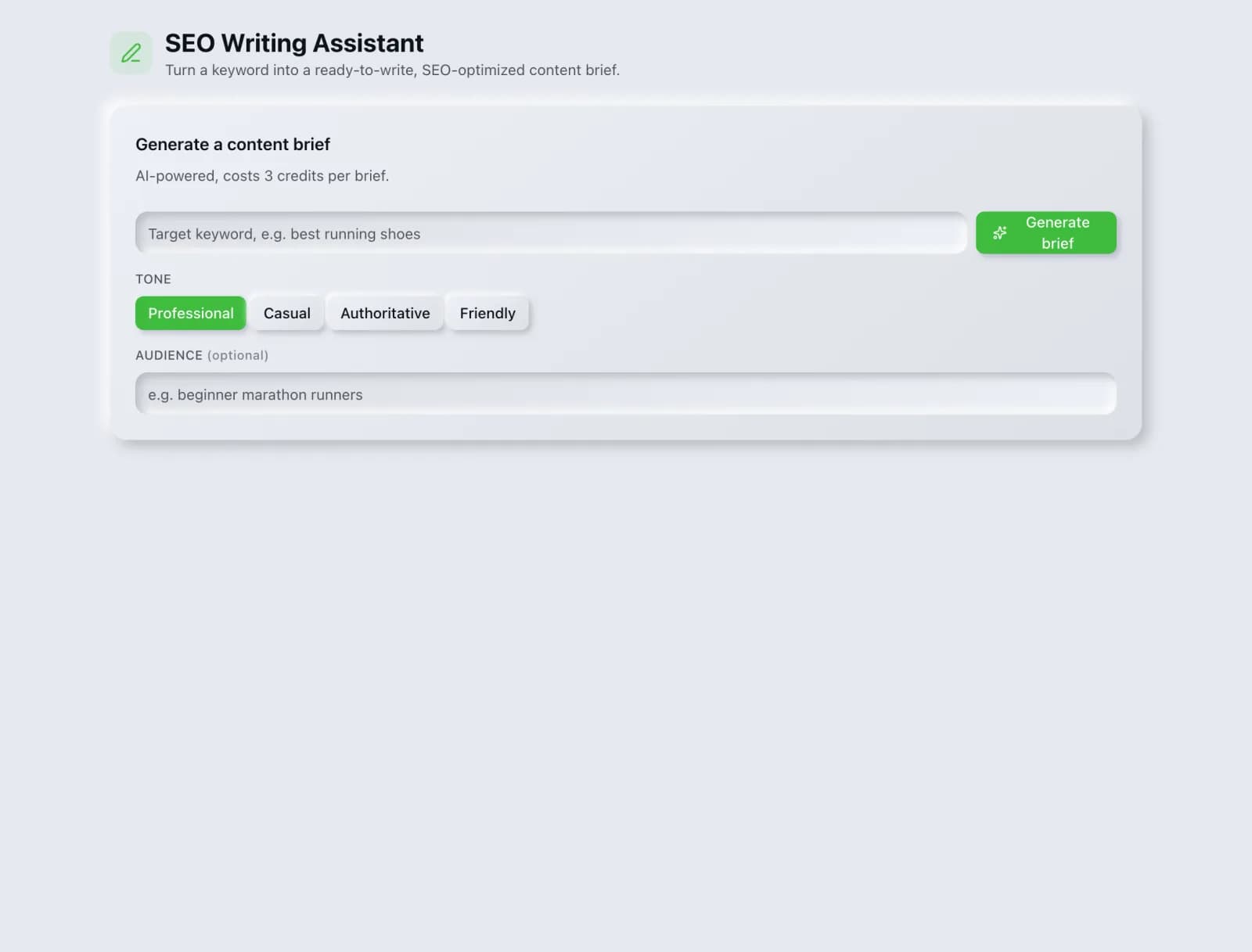
Turn a target keyword into a complete, rank-ready brief: title options, meta description, a full outline, FAQs, internal-link ideas and a draft intro.
What you get
Everything SEO Writing Assistant delivers, out of the box.
Title & meta options
Full content outline
FAQ + intro draft
Optimized for AI answers
How it works
From input to insight in three steps.
Enter your URL or keyword
Point SEO Writing Assistant at any page, domain or search term, yours or a competitor's.
SEO Roger analyzes it
We run the analysis with Claude across the major AI engines in seconds.
Get a prioritized report
Read a clear, ranked breakdown of exactly what to do next.
Related tools
More from AI Visibility.
What is SEO Writing Assistant?
The SEO Writing Assistant turns a target keyword into a complete content brief: title options, a meta description, a full section-by-section outline, the questions to answer, internal linking suggestions and a draft introduction. It costs 3 credits per run.
How to use SEO Writing Assistant
From signup to shipped fix, this is the whole loop.
- 1Create a free accountSign up in under a minute. No credit card is required, and your first site scan works without an account at all.
- 2Point SEO Writing Assistant at your siteEnter the URL or domain you want to analyze. You can run it on your own site or on a competitor's.
- 3Let it pull the live dataSEO Writing Assistant fetches the current state of the page or domain and runs its checks. Most runs finish in seconds.
- 4Read the ranked findingsResults come back ordered by impact rather than by count, so the issue costing you the most traffic is at the top, not buried under cosmetic warnings.
- 5Ship the fix, then re-runApply the recommended change, or let Roger AI draft it for you, then run the tool again to confirm the issue is resolved and track the improvement.
Why SEO Writing Assistant matters
The expensive part of content is not writing, it is deciding what to write. A writer given a keyword and no brief spends hours reconstructing what the piece should cover, guesses at structure, and produces something that reads well but misses the questions readers actually asked. A brief converts that ambiguity into a specification before anyone starts drafting.
Search is no longer only Google. ChatGPT, Google AI Overviews, Perplexity, Gemini and Claude answer a growing share of queries by reading the same pages crawlers do, then citing a handful of sources. SEO Roger keeps both audiences in view: the classic SERP and the AI answer, from one workspace.
Who it's for
- Brands that want to be recommended by ChatGPT, Perplexity and AI Overviews, not just ranked in Google
- In-house SEOs who need visibility inside AI answer engines without stitching three tools together
- Agencies and consultants producing client-ready findings, fast
- Founders and marketers who want the fix, not just the metric
SEO Writing Assistant in depth
The outline carries most of the value
Titles and meta descriptions are quick to write. The outline is the part that decides whether the piece succeeds, because it determines coverage. Search engines and AI answer engines both reward content that comprehensively addresses a topic, and comprehensiveness is a structural property fixed at outline stage. A page missing three of the eight questions readers have about a subject cannot be rescued by better prose.
Why the FAQ section does double duty
Explicit questions with direct answers underneath serve two audiences at once. Readers scanning for one specific thing find it without reading the whole piece. Answer engines, whether that is a featured snippet or a generative AI response, need a self-contained passage that answers a question without surrounding context to make sense of it. Question-and-answer structure is the format most likely to be extracted and quoted, which is why it is in every brief.
Internal links belong in the brief
Internal linking is the highest-leverage thing most content teams neglect, because it happens after publication when everyone has moved on. Putting link suggestions in the brief means they get added during drafting, when the writer has the context to place them naturally. This matters more than it sounds: internal links are how authority moves around your site and how search engines discover the relationships between your pages.
A brief, not a finished article
The draft introduction is a starting point to react against, not copy to publish. Content that reads as generated performs poorly with readers and increasingly with search engines, whose guidance targets content produced primarily to rank rather than to help. The brief is scaffolding. The expertise, the specific examples, the opinions and the things only your business knows are what make the finished piece worth publishing, and those have to come from a person.
SEO Writing Assistant questions, answered
How many credits does a brief cost?
3 credits per brief.
Does it write the whole article?
No, deliberately. It produces a brief plus a draft introduction. Publishing wholesale generated articles is a poor strategy: it performs badly with readers, and Google's guidance explicitly targets content created primarily for ranking rather than for people. The brief removes the blank page problem and leaves the substance to you.
Will Google penalize AI-assisted content?
Google's stated position is that it rewards helpful, reliable content regardless of how it was produced, and targets content produced primarily to manipulate rankings. Using AI to structure and plan is not the problem. Publishing large volumes of thin generated pages is. Assistance is fine; substitution is the risk.
How long should the finished piece be?
As long as the topic genuinely requires and no longer. Word count is not a ranking factor, and padding to hit a target actively hurts by diluting the parts that answer the question. The outline is a better guide to length than any number: cover every section properly and stop.
Can I use it for pages other than blog posts?
Yes. It works for any page with a target query, including product, category and landing pages. Just be careful to match intent: a commercial query needs a page that helps someone choose and buy, not an article structured like a guide.
How is this different from Topic Research?
Topic Research works at the level of a whole subject area and tells you which pages to create. The Writing Assistant works at the level of one page and tells you what goes in it. Use Topic Research to plan the set, then this for each piece in it.
Ready to try SEO Writing Assistant?
Create a free account and run it in minutes, plus 55+ other SEO and AI-visibility tools in the same workspace.