
Topic Research
Build topical authority, cluster by cluster.
Get a pillar-and-cluster content map for any niche: the pillars, subtopics and target keywords you need to own a topic in search and AI answers.
What you get
Everything Topic Research delivers, out of the box.
Pillar + cluster map
Search-intent tagging
Target keywords per cluster
Content-angle ideas
How it works
From input to insight in three steps.
Enter your URL or keyword
Point Topic Research at any page, domain or search term, yours or a competitor's.
SEO Roger analyzes it
We run the analysis with Claude across the major AI engines in seconds.
Get a prioritized report
Read a clear, ranked breakdown of exactly what to do next.
Related tools
More from AI Visibility.
What is Topic Research?
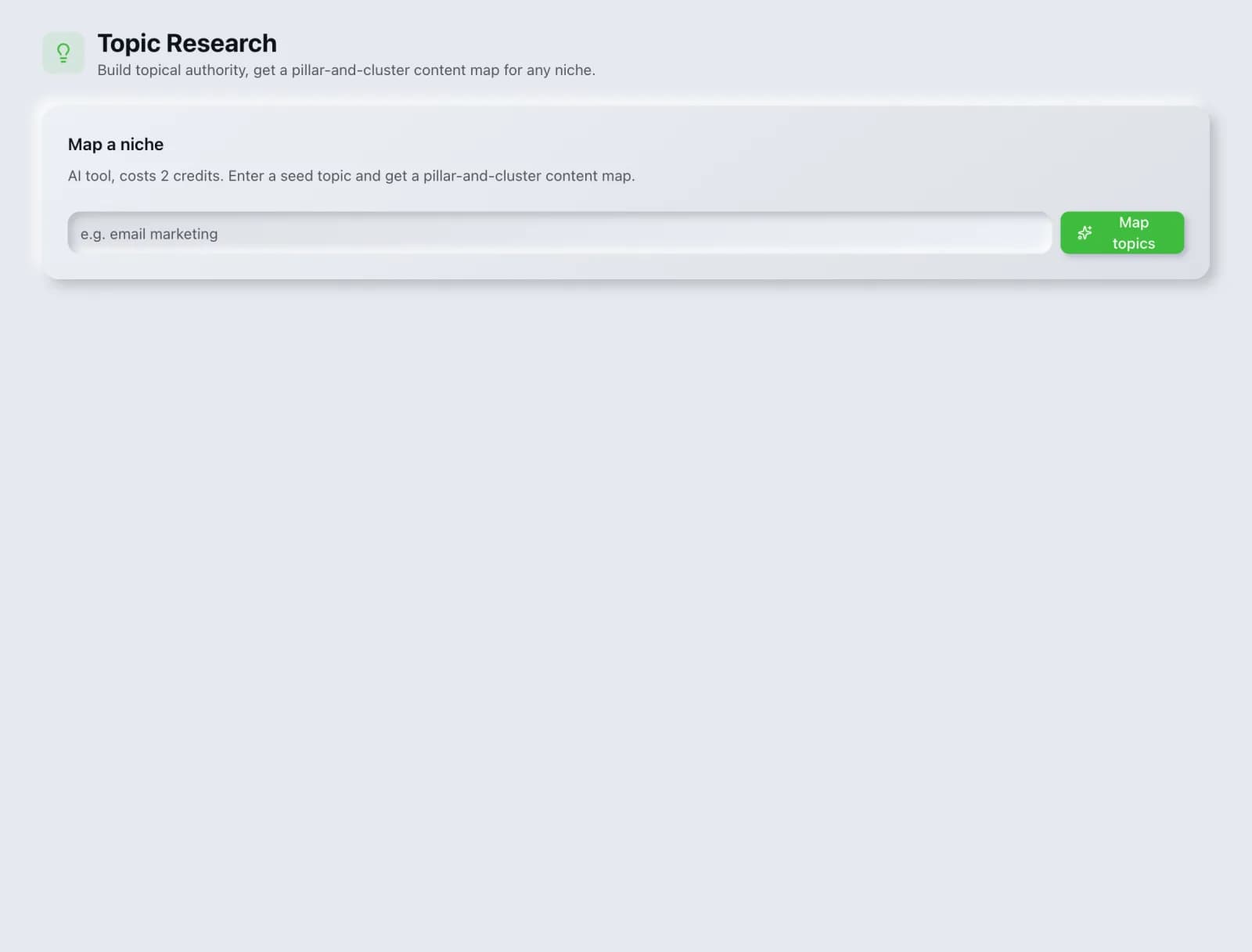
Topic Research produces a pillar-and-cluster content map for a niche: the broad pillar topics, the subtopics underneath each one, and the keywords that belong to each subtopic. It is the plan for owning a subject rather than a single query. It costs 2 credits per run.
How to use Topic Research
From signup to shipped fix, this is the whole loop.
- 1Create a free accountSign up in under a minute. No credit card is required, and your first site scan works without an account at all.
- 2Point Topic Research at your siteEnter the URL or domain you want to analyze. You can run it on your own site or on a competitor's.
- 3Let it pull the live dataTopic Research fetches the current state of the page or domain and runs its checks. Most runs finish in seconds.
- 4Read the ranked findingsResults come back ordered by impact rather than by count, so the issue costing you the most traffic is at the top, not buried under cosmetic warnings.
- 5Ship the fix, then re-runApply the recommended change, or let Roger AI draft it for you, then run the tool again to confirm the issue is resolved and track the improvement.
Why Topic Research matters
Search engines and AI answer engines both assess whether a site demonstrates genuine depth in a subject, not just whether one page matches a query. A site with one article on a topic and a site with a properly linked cluster covering it thoroughly are treated very differently, and the second one is much harder for a competitor to displace. Depth is a structural advantage that accumulates.
Search is no longer only Google. ChatGPT, Google AI Overviews, Perplexity, Gemini and Claude answer a growing share of queries by reading the same pages crawlers do, then citing a handful of sources. SEO Roger keeps both audiences in view: the classic SERP and the AI answer, from one workspace.
Who it's for
- Brands that want to be recommended by ChatGPT, Perplexity and AI Overviews, not just ranked in Google
- In-house SEOs who need visibility inside AI answer engines without stitching three tools together
- Agencies and consultants producing client-ready findings, fast
- Founders and marketers who want the fix, not just the metric
Topic Research in depth
How pillars and clusters actually work
A pillar page covers a broad subject at a level anyone can follow and links out to cluster pages that go deep on each subtopic. Every cluster page links back to the pillar. The linking is the mechanism, not decoration: it tells search engines these pages form a coherent body of work on one subject, and it concentrates authority on the pillar, which is usually the page targeting the most competitive term.
Why depth outperforms breadth
Twenty articles spread across twenty unrelated subjects produce twenty weak pages with nothing reinforcing each other. Twenty articles covering one subject thoroughly produce a cluster where each page strengthens the others through internal links and shared topical relevance. The second approach ranks better and is far more defensible, because a competitor has to replicate the whole cluster rather than beat one article.
Clustering is what stops you building thin pages
The most common content-planning mistake is treating every keyword variant as its own page. Ten phrasings of the same question are one page, not ten, and building ten near-identical pages creates exactly the thin duplicate content that gets demoted. A cluster map groups keywords by the underlying question, which tells you where the real page boundaries are.
Sequence the build
Do not publish the pillar and leave the clusters for later, and do not publish clusters with no pillar to link to. The workable order is to build the two or three highest-value cluster pages first, publish the pillar linking to them, then fill in remaining clusters over time, adding links in both directions as you go. That way the structure is coherent at every stage rather than only at the end.
Topic Research questions, answered
How many credits does it cost?
2 credits per run, making it one of the cheaper AI tools in the suite.
How many pages does a cluster need?
There is no fixed number. It needs enough to cover the subtopics a reader genuinely cares about, which might be five pages for a narrow subject or thirty for a broad one. Building pages to hit a count rather than to answer a question is how clusters turn into thin content.
Does the keyword data come with volume figures?
Topic Research maps the structure of a subject. For search volume, competition and cost per click on the specific terms, run them through Keyword Research, which pulls that data from a commercial keyword index.
How long does a cluster take to work?
Months, typically. Each page has to be crawled, indexed and assessed, and topical authority builds as the cluster fills out and accumulates links. Expect meaningful movement over a quarter or two rather than weeks. Anyone promising faster is describing an exception, not a plan.
Should I build one cluster at a time?
Yes, in almost all cases. Finishing one cluster properly beats starting four and completing none, because a half-built cluster has neither the coverage nor the internal linking that makes the approach work. Depth is the entire point.
How does this help with AI visibility?
AI answer engines synthesize from sources they judge authoritative on a subject. A site with thorough, well-structured coverage of a topic is more likely to be drawn on than one with a single passing article, for much the same reasons it ranks better in conventional search. The structural work serves both.
Ready to try Topic Research?
Create a free account and run it in minutes, plus 55+ other SEO and AI-visibility tools in the same workspace.