Accessibility Checker
Catch WCAG issues that hurt users and SEO.
Scan any page for WCAG accessibility problems: better for users, and increasingly a ranking and compliance factor.
What you get
Everything Accessibility Checker delivers, out of the box.
WCAG issue detection
Severity grouping
Per-element guidance
Free to run
How it works
From input to insight in three steps.
Enter your URL or keyword
Point Accessibility Checker at any page, domain or search term, yours or a competitor's.
SEO Roger analyzes it
We run the analysis with our full-site crawler in seconds.
Get a prioritized report
Read a clear, ranked breakdown of exactly what to do next.
Related tools
More from Site Audit & Monitoring.
What is Accessibility Checker?
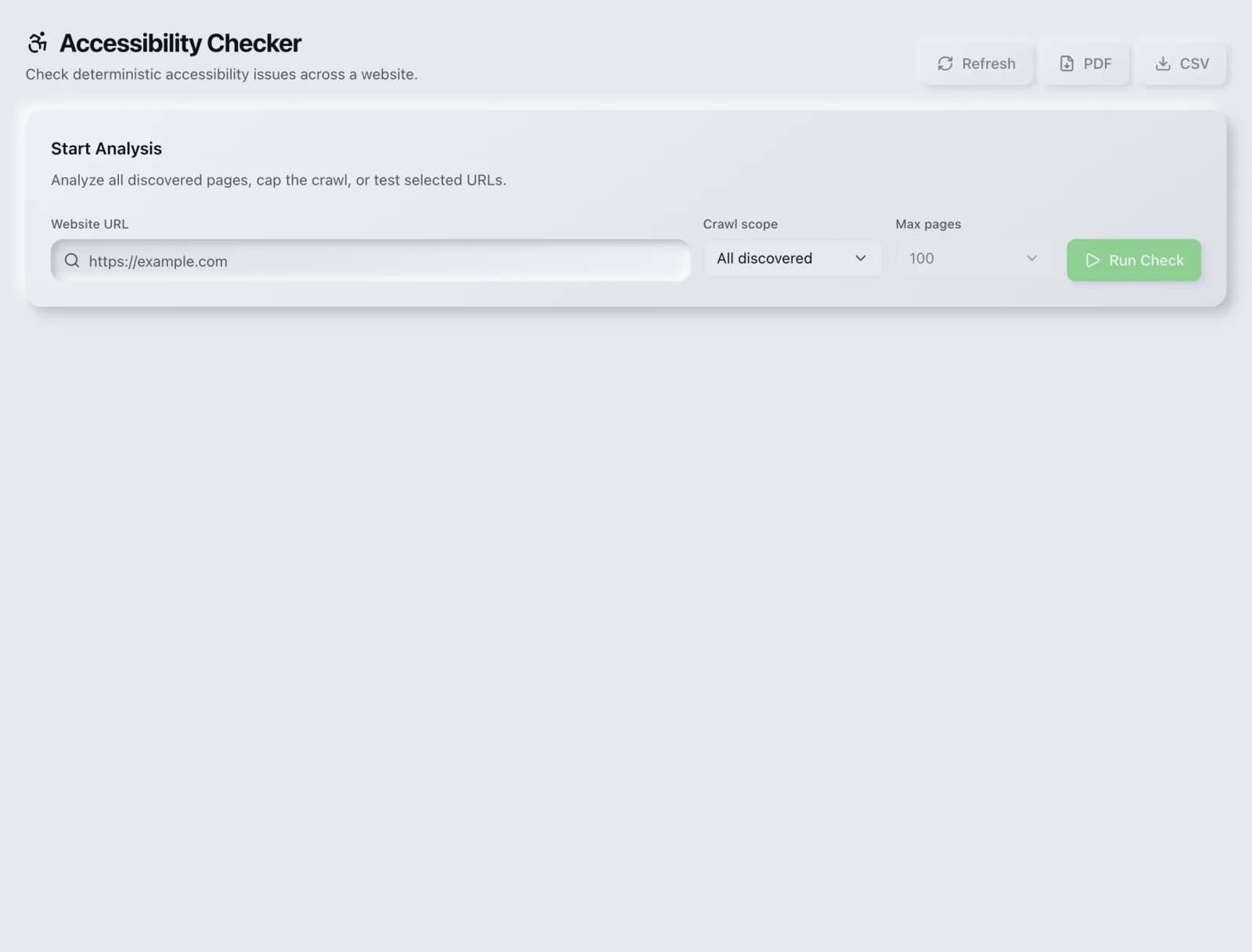
The Accessibility Checker scans any page against the Web Content Accessibility Guidelines and reports the barriers that stop people using assistive technology from using your site: missing alternative text, insufficient colour contrast, unlabelled form fields, broken heading order and keyboard traps. It is free on every plan.
How to use Accessibility Checker
From signup to shipped fix, this is the whole loop.
- 1Create a free accountSign up in under a minute. No credit card is required, and your first site scan works without an account at all.
- 2Point Accessibility Checker at your siteEnter the URL or domain you want to analyze. You can run it on your own site or on a competitor's.
- 3Let it pull the live dataAccessibility Checker fetches the current state of the page or domain and runs its checks. Most runs finish in seconds.
- 4Read the ranked findingsResults come back ordered by impact rather than by count, so the issue costing you the most traffic is at the top, not buried under cosmetic warnings.
- 5Ship the fix, then re-runApply the recommended change, or let Roger AI draft it for you, then run the tool again to confirm the issue is resolved and track the improvement.
Why Accessibility Checker matters
Accessibility is worth doing because excluding people from your site is a bad outcome on its own terms, and roughly one in six people live with a significant disability. There are two secondary arguments that also happen to be true: many accessibility fixes are the same fixes search engines reward, because both audiences depend on well-structured, properly labelled markup, and in many jurisdictions accessibility is a legal obligation rather than a nice-to-have.
Search is no longer only Google. ChatGPT, Google AI Overviews, Perplexity, Gemini and Claude answer a growing share of queries by reading the same pages crawlers do, then citing a handful of sources. SEO Roger keeps both audiences in view: the classic SERP and the AI answer, from one workspace.
Who it's for
- In-house SEOs who need technical health and crawlability without stitching three tools together
- Agencies and consultants producing client-ready findings, fast
- Founders and marketers who want the fix, not just the metric
Accessibility Checker in depth
Where accessibility and SEO genuinely overlap
Alternative text describes images to screen readers and to image search. A logical heading order helps someone navigating by headings and helps a crawler understand document structure. Descriptive link text serves a screen reader user skipping between links and a search engine reading anchor text. Captions serve deaf users and give search engines text to index. These are not separate jobs done twice. They are one job that pays twice.
Where they do not overlap, and honesty matters
Plenty of accessibility work has no SEO benefit whatsoever. Colour contrast, focus indicators, keyboard navigation order and touch target sizing matter enormously to real users and do nothing for rankings. Selling accessibility purely as an SEO tactic leads teams to do the half that ranks and skip the half that actually helps people. Do it because it is the right call, and take the SEO overlap as a bonus.
What automated testing can and cannot catch
This is the most important caveat on the page. Automated tools reliably catch roughly a third of accessibility issues: the machine-checkable ones such as a missing alt attribute or a contrast ratio below threshold. They cannot tell you whether alt text is meaningful rather than merely present, whether your tab order makes sense, or whether a custom component announces itself correctly. A clean automated report is a floor, not a certificate. Real conformance needs manual testing with a keyboard and a screen reader.
Which level to target
WCAG defines three conformance levels. Level A is the minimum and leaves real barriers in place. Level AA is what almost every regulation and procurement policy references, and is the sensible target for a normal commercial site. Level AAA includes requirements that are impractical or impossible for some content types and is not expected sitewide. If someone asks what standard you meet, the answer they want is WCAG 2.1 or 2.2 Level AA.
Accessibility Checker questions, answered
Does accessibility directly affect rankings?
Not as a distinct ranking factor. Google has never confirmed an accessibility score in its algorithm. The connection is indirect but real: accessible markup is well-structured markup, structure is what crawlers parse, and better usability improves the engagement signals that do matter. Expect an indirect benefit, not a direct lever.
Does this tool cost credits?
No. Accessibility scans are free on every plan. They run on our own infrastructure with no paid third-party API behind them.
Is a clean scan enough to be legally compliant?
No, and this is worth being blunt about. Automated testing catches a minority of accessibility issues, so a clean report does not establish conformance and should not be presented as legal cover. It gets the machine-detectable problems out of the way. Anything with legal exposure warrants a manual audit by someone who tests with assistive technology, and legal advice for your jurisdiction.
What are the most common issues you will find?
In practice, four dominate: images missing alternative text, text with insufficient contrast against its background, form inputs without associated labels, and heading levels skipped or used for visual size rather than structure. All four are cheap to fix once found, and all four are on almost every site that has never been checked.
Should decorative images have alt text?
They should have an empty alt attribute, written as alt equals nothing, which is different from having no alt attribute at all. An empty alt tells a screen reader to skip the image, which is exactly what you want for a decorative divider. A missing attribute leaves the screen reader to guess, and it will often read the filename aloud.
Where should I start on a site that has never been checked?
Start with your templates rather than individual pages, because a contrast problem in your button style or a heading structure problem in your article layout repeats on every page using it. Fix the shared components, rescan, and only then work through the page-specific findings that remain.
Ready to try Accessibility Checker?
Create a free account and run it in minutes, plus 55+ other SEO and AI-visibility tools in the same workspace.